| Plays |
 |
 |
| Essays |
 |
 |
 |
 |
 |
 |
| Critique |
 |
 |
 |
 |
| Novels |
 |
 |
 |
| Short |
 |
 |
 |
 |
| Selected |
 |
| Political & |
 |
| For Posterity |
 |
 |
 |
|
|

If a Priory is where a Prior resides, then a Theory is where a God resides
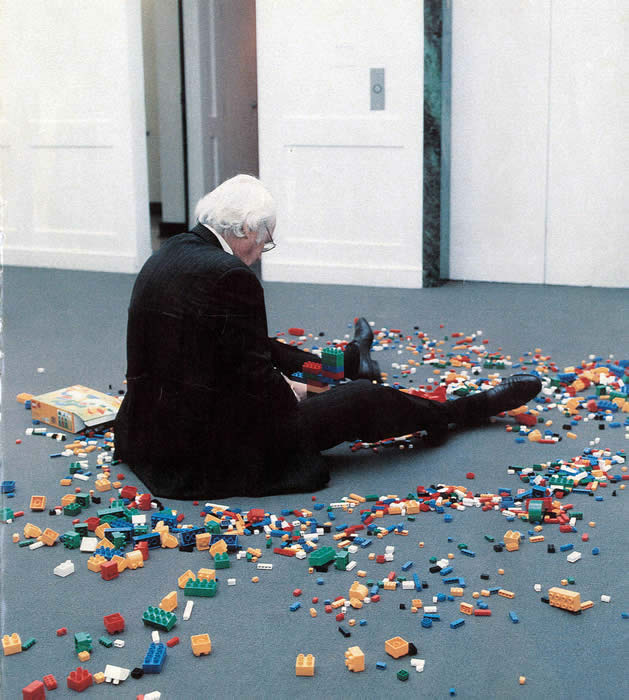
Do not disturb! Philosopher at work!
PHILOSOPHICAL ESSAY
Fairy Tales: A Narrow Escape
To be, or not to have been at all! And this narrow escape...: no more make-believe, no more Teddy Bears, only brutal, total honesty or else life is nothing but a subway to nowhere with no exits, and only ill-lit stops! Where the only Socratic dialogues on offer are nothing but frozen beliefs and naive desires that should be played out symbolically, not meant to become mental health issues.
Subtext:
If our ancestors could have seen what we see now, instead of our nearby solar system, with the naked eye, comfortable, obvious, there only for us, to be used for predictable earthly power grabs in its name, or to dance to for rain.... We probaly wouldn't have had all those awful, private, violent religion! With more true humility, and no appropriation!
Still, some dismiss cosmic space with a shrug, washing it off or away. But we simply can't ignore this is as mere wallpaper or a permanent nightclub ceiling in the sky, by not for a moment allowing it to interfere with our fantasies... For one serious look at the Tarantula, the Rosetta Nebula or else the NGC 2608 Galaxy each with their trillions of stars, and it's obvious that we cannot think or dream our way out of this thing, leaving the wilderness of time!
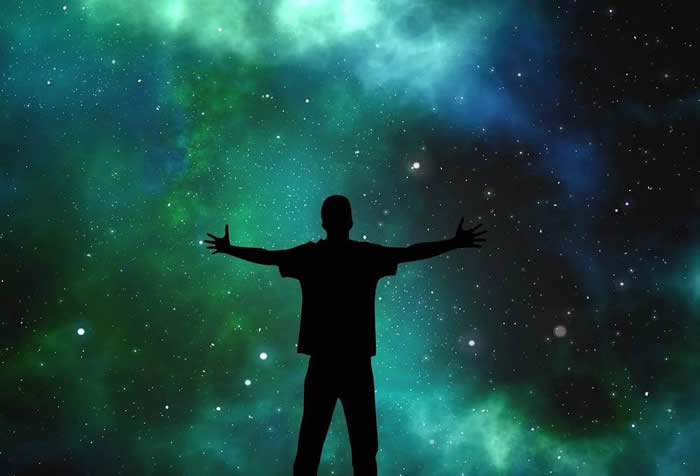
Though once I myself thought I spotted a rock garden with a giant Saguaro Cactus up in the sky, like a Mayan pretending it was a lonely human spirit waving at me, me then desperately waving back at him...! But then again, Aztec and Mayan cultures disappeared without apparent cause or fight even before the conquistadores arrived! Entire cities and pyramids voluntarily abandoned, population again spreading right across Mesa-America’s vast regions without urban conglomerations. The theory being that further South from present day Mexico deadly volcanos had erupted, people in a last attempt trying to remake lives in what had become long nuclear-like winters because of air pollution, illness and toxic fires. Whereby they became disenchanted with their rulers and their gods, closing shop on their hierarchies and their beliefs, returning to the task of survival by leading simple daily lives in country sides as some sort of atonement for having been so stupid and misled… Events and a personal courage that the rest of the world should be inspired by, not damn deliberate, push-button fairy tales! So, a grand, courageous, human rebellion of sorts...
Thoughts like these constantly racing through my mind for on another level I'm pretty sure we were a cosmic accident waiting to occur. Never supposed to stick around this number of rotations under our sun, sucked into the maelstrom of time only to come down from trees to turn into bi-pedal beasts with attitude, breaking that horrible food chain merely to drive some ugly Honda and make the same preposterous mistake as some tiny ant from Andorra absurdly trying to explain China... or space!
Still, critical thinking is a 'must' for a prosperous, open society, thus my:
Reflections of an ordinary, early XXI Century citizen
Early Monday, March 10, 2025 Draft
(Yes, time to rise; no rest for the wicked! So get ready to run for the front door or bolt it from the inside or every man's dilemma...!)
(Hey there, watcha talkin 'bout, Willis? At this point I have not much more to add, perhaps in a decade or so if I'm still around. Meanwhile take away from this what you want or wish to dispute, as long as you give credit where it is due and so much the elegant thing to do...)
By
Anthony Steyning
"Modern art is what you can get away with," false prophet Andy Warhol told us, his work taking the cake and the Banality of Easel the way someone described it. The point at which credulity definitely starts taking it on the chin and the word 'travesty' enters many people's mind, especially when facing an arranged bunch of turds nailed to a museum wall, or some other display of the kind!
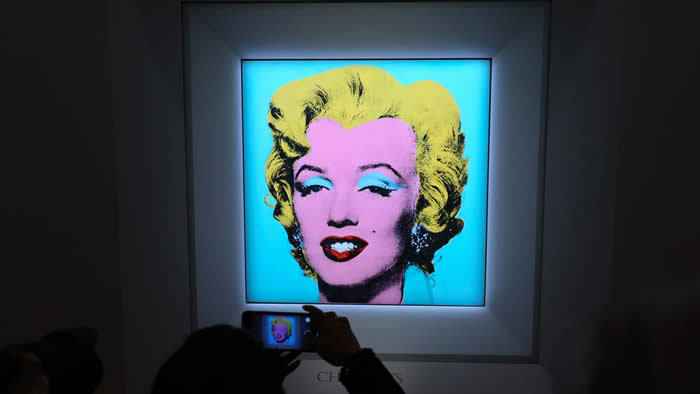
(Art like a religion often rammed down our throat, like one of 23 'original' silkscreen copies by Warhol, Pink Marilyn, that just sold for a ridiculous 195$ million and an actual curated museum piece! And here I thought modern art's all about composition, craft, beauty, exquisite hand-eye skill not printed stuff... Yet this one's so much like the straight-faced naming of a dead empty pale canvas as.... White Ship in Deep Fog!)
Much the same thing with philosophy and religion, man's most venerated cerebral and spiritual enterprises. Unchallenged by multitudes thirsting for reverent fantasy as addictive as alcohol and hamburgers: fake reassurance by way of endless analysis and explanation whereby self-satisfied proponents take themselves as seriously as contemporary art's high priests do!
But does something really represent a truth, simply because the gullible no longer question it? For I do assume my existence, but do they? And above all, does He?
By constantly pretending that he's going some place else, man taking his eye off the ball of life! But enough's enough, one god too far, Buddha already said about thousands and thousands of Hindu gods; life's not a prelude, some prologue, our funeral parlors some kind of departure lounge, a mezzanine to heaven! For man has to count for something, stand alone if he possibly can with Antonin Artaud repeating this notion when to some at least he cruelly wrote Pour en finir avec le jugement de dieu, wherein he asks us to stop this 'divine' nonsense with our imaginary friend aided and abetted by herd-instinct and herd-spirit. Because if man created myths or fairy tales to trick himself into lifting his own spirit, dealing with his own mind by way of stepping beyond himself so he could look upon himself and heal himself plus give himself that extra bit of courage and strength in the face of cruel and often endless setbacks, then for a time despite silly, almost immediate, equally invented prophecies, miracles and taboos, this was fine. Still what soon became organized group delusion and even group psychosis was never born in tropical forests or in valleys but on vast desolate plains and deserts, man in search of protection and comfort using even older superstitions and allegories dealing with his earliest existential fears and needs. However and usually endless his tales, these ultimately tended to stop and block minds, humanity ending up stealing its own innocence by taking its fabulations literally, slowly turning them into destructive confabulations. Most not understanding that the truth even when complex and harsh always turns out to be relatively short, and when not perverted but faced head-on inevitably and conversely.... leads to ever more confidence, strength and light.
For inside the hourglass of time there's a huge sandbox where all the kids play as well they should, but only as long as the sand doesn't harden into cement. Man beginning to believe his lengthy, embroidered fantasies, his fictions, imposing them as if they were the absolute truth, quickly protecting instant orthodoxies as precious property, but also slowly creating the beginning of his own degradation. Because fables or myths are dreams - better still a series of pretty fibs - but what slowly becomes an elaborate lie, however well meant, however well told, also represents the seed of destruction that every grand falsehood carries within. After what starts as delightful, instructive play turning into a concrete nightmare, everything black, or white, nothing grey, no life in between, no respect, no tolerance, no Laurel, no Hardy, no Statler, no Waldorf, just living death inside the suddenly armoured castles that we built in those sandboxes of symbolic thought, places where gradually even time fled... Though with all this should one day the Holy Virgin actually show up 'live' in Mecca everything I wrote this far... should probably be reconsidered!
- Ask the playwright Pirandello, his characters are real, but their author is the illusion! For the only force stronger than a creed itself is the compulsion to make one up at all cost... or shop around for one... After all, what's life without that Teddy Bear?
Quite similarly, what's found at the opposite end of the scale is immodest pride as for its part formal western thought is built on the implication, its point-de-départ, that should we not be there, well, then nothing's really there or worth discussing. That unless a person can give birth to him or herself our collective death would be the death of meaning. As if this planet had none of it long before we arrived, accommodating millions of years of different life?! And about time we admitted and accepted that just like we have no idea who, what or where we were before we were born, is the same place we're headed after we're gone. Producing the ensuing battle between the predictable unreal vs. the unpredictable real, with the only worthwhile orchestral part the damn knowable one, that place where all our symphonies play... And as if all of this doesn't strictly imply carpe diem, carpe noctem, that what we see is what we get with a single, perfectly crafted mirror needed as only tool to save our ass! Yet while wild animals don't recognize themselves when placed in front of a large mirror deep in the jungle; it scares them, they jump, run away or attack, the smart ones going on to look behind it, man for all his marbles seemingly also quite incapable of seeing himself for what he really is.
- Master philosopher Foghorn Leghorn: Ah say, boy, if you can't take a joke, ah suggest you avoid mirrors!
And ah don't know if ah should resent or do in fact resemble Leghorn's remark, but philosophy's sole function should be the removal of all nonsense from the world when all it does is confound and compound, never really ceasing to create rather than dismiss exquisite, endless, near lyrical examinations and rivaling conjectures! I know, no Sein no Zen, but there's more to it than that! For notions like Heidegger's forever doctrinaire Sein and Da-sein or Descartes' Je pense, donc je suis, I think therefore I am, are critically flawed as deprived of our consciousness... 'being' in its largest sense never stops to be! Plus that the first thinker's thru his by definition self-limiting notions of Sein, or their opposites for like it or not when speaking endlessly about Sein one automatically invokes Nicht Dasein or Un-Sein or maybe Nicht-Zu-Hause-Sein (Nobody-Home-Sein) given that barely 10km up or down from the human placenta all biological life ends and therefore in the scheme of things ours really plays such an immaterial part that it makes this racist scoundrel's convoluted postulations completely redundant and gratuitous. A form of intellectual wanking with all of Academia still watching in awe, like some Woody Allen preposterously gasping... 'You Were Great Last Night! Absolutely Brilliant The Way You Wank!'. And so by being stuck in this give or take 20km of rarified space reduced by intellectual strip mining, unintentionally alluding to non-being but still not offering or presenting anything resembling extra life stimulus, quite the contrary by reductio ad absurdum... this Black Forest piece of work nearly kills one hell of a party!
As for Descartes, the most that we could let him get away with is turning I think, therefore I am into I think therefore I am what or who I am (i.e. as opposed to others or animals). Though again, all of which and everything put together in the end still represents our persistent irrelevance, that all we really have is us, that we cannot exist alone! And why the Zulu word Ubuntu makes so much more sense, meaning: I Am... Because We Are! Pleading for applied humanism and going a long way towards what André Breton exhorted: I think, therefore I consider and (may) disturb and why Duchamp & Tzara came up with Dada-sein! Or else what about Camus' saying I revolt, therefore I exist, getting ever trickier for if I don't revolt... I don't exist!? And why Unamuno's simple I am, therefore I think, probably is the safest way to describe us if needed to be stated at all! However, what's wrong with my Yes, I perceive but it won't change a goddamn thing!? Then again one might as well just say I fuck, therefore I am which happens to be equally 'significant'! And therefore, back to Ubuntu and Zulu wisdom for after deft, not daft, consideration... Us... all there is, folks!
- If life is a fortuitous accident we should strive to preserve it, not ad tedium investigate, dissect and use it like some industrial product! Treating false beliefs like a hoax, a joke inside what is no joke in the way Robert Frost did, in saying: O Lord, I do apologize for my joke on You, as long as You apologize for the huge one you pulled on me!
When re-reading so many hallowed texts then, consider the self-indulgent hokum too often meriting some sort of stage direction saying: STOP! Here Mind Clearly Disappears Up Rectum! Because, one more time, after close scrutiny nearly all established conventions ultimately point in one single direction---they confirm our pre-eminence and successful continuity with a mindset far more interested in bunker consolidation and arid preservation than in keeping structures open to further experience and thought. In so many words the re-study, re-re-design and strengthening of the same old intellectual harness. And it's hard not to consider oneself above the bacillus when man can slice bread, drive a car, exteriorize, even draw pictures, and it cannot. The reason man's still secretly convinced he's the measure of all that matters, that there's some sort of finality to the scheme of things and this finality is him, when there's every indication that there's no scheme and the earth the center of nothing except to those caught dead on the third and most beautiful albeit somewhat obese bauble from 'our' sun. A sun that thanks to Galileo and despite his Pope's virulent objections doesn't 'rise' anymore than a large building slides up and down its elevators, that a guy on a donkey invented the universe, or that a woman's hand shrinks placed on a rising phallus. So do let's keep proper perspective and admit that we must rise to prove ourselves to ourselves for so called nothingness and absence of human existence or awareness are not synonymous, eons simple episodes during which nothingness arising from emptiness is not only a non sequitur but a non plus, though the answer to the question 'What is is....??' admittedly remains a the killer.
- With the help of the new Webb, floating telescope looking up at the firmament, what we see is a huge astral spiderweb...
- But where is the spider?
- Because it isn't us?
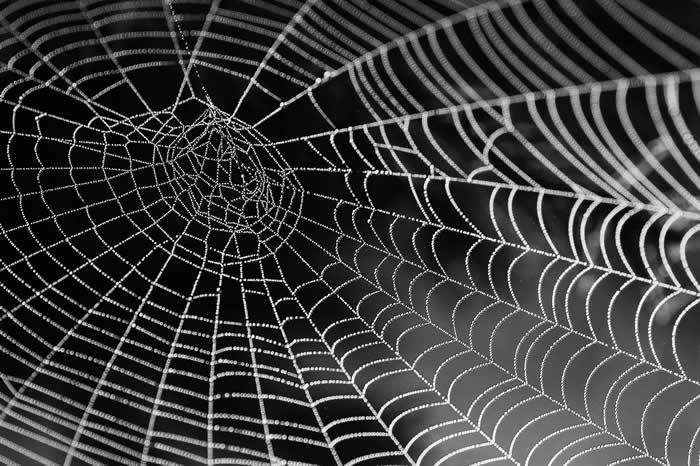
Including the ultimate realization 'How did the Universe itself originate?', not some vast vacuum-no-nuthing but on the contrary a trampoline, invisible elastic strings holding everything together? Spacetime as it's called, which always confused the hell out of me as it sounds so much like Timeshare, which of course in a manner it is... I mean, we know each other so much better by now so why not give the whole thing an easier, more accessible name like Larry; as if it were a threatening hurricane, which it is isn't it as far as little old us are concerned!? Yes, what is this obscure cosmic fabric, this bully both holding, bouncing and pushing around glitter balls inside some giant pinball machine. One without tilt or flippers to stop it all or keep it going the way we want! A Wurlitzer in the sky, only so much larger and deadlier... (Hi, is Larry home? No, he's out... Playing mortal Tom and Jerry!) Or else as in Jacques Brel's La Valse à Mille Temps, holding not only raging suns and all their obedient planets but according to this minstrel, our minds as well?' (On the other hand I'm glad everything does rotate, pulling the strings of gravity or we'd slide right off and out, and then what? No more ham and eggs, no more Superbowl, the end of all passion and love?)
- About the Big Bang theory: First there was nothing, and then it exploded... If you can figure that one out, please give me a call! But I tell you right now, my position on what it all means is not 42, but 121 + 6 ....
But then, suddenly, in all this darkness... LIGHT! Perhaps by itself only tamed violence, and sure light are traveling particle drops of energy but what's inside the particle, this photon carrying an electron; where did it get it, where did this come from, what is it, that is to say what exactly is this glow ever so briefly getting the upper hand in defeating total obscurity? Or is it some sort of dust, an explosion's dust, therefore in our case not moon but sun dust? And what is this elixir of life called water? How does it form? Where does it come from? A few buckets first arriving by icy meteorites? But then can its molecules multiply all by themselves into huge oceans, for that's an awful lot of buckets and an awful lot of meteorites!? And again what is this thing called energy, in the end turning itself into matter or the other way around? What really are electro-magnetism, heat, cold, this light, gravity and all their waves? Where does deadly space radiation come from? I know, I read all about it, exploding Supernovas, but why? Collapsing or colliding stars, the Universe's very own Demolition Derby? Yes, we all know those manifestations by now, or that gasses can become matter, but could you put a small amount in a paper bag for me? OK, thanks, but wait, on second thought I'll only have 1 pound of each, but do throw in 1 can of gravitons and a pinch of heat! For all put together these not only make us and nearby things move, but also matter millions upon millions of miles away! All of which we eloquently note, describe, measure and calculate - and by the grace of which we live and die - but still cannot factually explain? Or never ever perhaps, but in the scheme of things and strictly on a human scale even this awareness remaining utterly meaningless...
On the other hand let's keep questioning, isn't that the end-point of true intelligence...? Raising smart questions, but refusing to make up silly, self-serving answers?! Dead-honesty, the word!? As for the rest and sofar so good, most modern western thought not so much the case of pure perception as one busy dealing with its own mechanics; a bursting into action called will, i.e. to be is to do. So all in all mainly the provision of some sort of indexation while pretending to supply certainty but only carefully constructed theoretical truths no more real than those large, inane and inanimate wax figures in morbid musea staring us in the face. Or something like cheeky Gustave Courbet's The Origin of the World, a portrait hyper grotesque and equally self-absorbed suggesting life is but a cunt. And yet with ultimate intellectual perversion others brazenly suggesting that we're not even here, that everything is an illusion and a hologram though after the onion soup a toilet door regrettably left ajar pretty well kills off this notion.
Still, with all of this there's absolutely no doubt that a mind stays undernourished and utterly useless without developed senses, except for the cerebellum of course, the electric impulse controlling our muscles so we can move around and ingest and swallow in order to keep going. Wherein there's no cognition without sensory perception, but where - except in Plato's Cave and in the form of allegory - are the dissertations that include references to our planetary environment, to the brain itself, our touch, our ears and our eyes, our neurocognitive setup? The stuff vacuum-sealed, bottled-thought custodians and careful caretakers still ignore, but of which these days entire populations are aware? Those curators who will react to a massive overhaul of modern thinking only if imposed by some Deus Ex Machina, which never seems to arrive. For what's needed what I would call not only Gestalt psychology and Gestalt history, but Gestalt philosophy. As in established curriculum and academically speaking is the nose not glamorous enough? And what is it exactly that sounds created by Schubert, Rachmaninoff or Prince make us cry or shiver with joy, unleashing emotions that affect our reasoning even when Satie's meditative sounds stop us dead in our tracks. Not even phenomenologists touching on the flesh, the blood, the daily reality of sentience, yes, which Kant's or Schopenhauer's internal and external paths coincided in each one of them, their neurons, neurotransmitters and hormones having made them generate and arrive at their thoughts? And should we not first and foremost accept the absolute primacy of certain objects and conditions: a rock not nearly as inert as we think and still capable of flowing, or else temperature, better said that heat again, this collision of molecules producing it but still just about all we know, or that it rains with or without us, gravity, oxygen....details like this? Far removed from human speech, interpretation, memory and Gutenberg tooled retention in order to once and for all prevent the tail from wagging the dog or the small cog from claiming to be the damn machine?
Q: Umberto! Why o why didn't you write: The Name of the Nose? Especially when even a phenomenologist won't, except of course if it happens to be phenomenal...
A: Ma che cazzo, ragazzo; whatta are you babbling on about!?
But wait this is not all, one has to lift the box sometimes to find out what's underneath it too, for what if biology had connived to make the praying mantis the size of a horse? I don't think we'd be writing and reading like this at all! Life by itself not only a blessed chemical incident, but a biological battle of proportions, man luckily and by accident turning out to be about the right size given the measure of his planet. Providing him with enough living space to walk away from displeasure or misadventure often by careful choice, and thereby luckily not the owner of a physical structure so large that he could have stepped over a small mountain or a large hill as in mythology, in Gullivers Travels or like Gargantua and Pantagruel, or - much like the dinosaur - he would have disappeared long ago. On the other hand fantasy thrillers have been made with men the size of microbes or else as somewhat larger insects and all of which had it been true would have created an entirely different situation on earth, yet something never taken into account in thrall as we are with ourselves, the terrific way we are yet also nothing but extremely large insects. So that perhaps we are Samsa as in Kafka's Metamorphosis, one who didn't become but already WAS the bug.
Strictly speaking then what we have and what we are and despite all that momentary but totally circumstantial prominence of ours is not only directly thanks to the hand and that wonderful thumb allowing the use of tools directly leading to our cerebrum's gradual expansion, plus the use of our larynx and so the formation of a voice with which to communicate specifically not just grunt, but to the accident of comparative proportion. Whereby the first huminid who said 'Would you like another coffee, Ralph?' set the vital first step in our as yet unforeseen domination. This, plus the mysterious presence of the all important clitoris - in academic terms all of us creatures of Coïtus Phallo Clitoris Causa - and all subsequent brawn making our physical size and ranking determine our consequent defensive thinking in dealing with endless outside peril. Yes of course this is lighthearted mental play but believe me or not, in nature size does matter... Whereby it still does and always did come down to the same, and remains the canard: I know, who else's, but our extremely superficial take on the world and beyond rules all only because so far no tangible, alternate, 'outside' condition has shown up teaching us anything superior or clearer... Careful, tangible I did say, but should this 'force' even exist, and in all likelihood and by definition advanced, and therefore wanting to dominate, enslave, patronize or ridicule... then what? Who wins? Anyway again if this is strictly an academic point it should still be taken into account if anything to force open and humble the clam of our mind, if necessary with the help of some crowbar...
My position then, with ultimate wisdom, can't we shrug it off for now? Shouldn't the affirmation of life keep us busy round the clock? Does there absolutely have to be a super-imposed 'take'? Has the foul, this different whiff of supposed but reckless certainty and learned self-importance not become quite unbearable? Even dangerous in places? Doctors of Divinity and Philosophy at one point having to be dragged out of their tofu sanctum sanctorum, their Prius car or their own mind so a thing like their mirror might help them get over themselves? Shocked into reality the way I was by a quick but sobering look at my own skeleton through a revealing X-Ray? Reminding me of my total nakedness and vulnerability with all of us too often forgetting that most of our convictions are linked to moments of structural self-assurance that are only an illusion of temporary timelessness?!
So yes, why not send the tenured and the ordained alone and naked into the Kalahari, forcing them out of their comfort bubble? While there re-igniting unbiased curiosity and uncertainty, for instance noticing an animal's hide or plumage perfectly assimilating the colours of surrounding? Pure mimetic trickery, for defence or for offence, by optical non-tactile transfer and nature's many ways of deception, the place where we too must have first learned to pretend and lie through our teeth?
No, I won't get into the kinetic force of it, other than to repeat this is not contact osmosis. But only one example of somewhere along the line a different, invisible perception/awareness between the animate and the inert occurs that we can't explain but must have included some sort of primal recognition factor. Colours and fake shadows turning into stunning camouflages far, far removed from old parchments, dead idioms, sublime theories and notions. Enough to reject stolid pontification over the excitement of fresh discovery, and also seeing how long our desert dweller's severe thirst for intellectual certainty outlasts the need for a simple gulp of H2O. For up to now are they, nay, most of us not mere well-fed, self-immersed loungers, owners of self-pleasuring speculation and abstraction instead of acknowledging that our only legitimate possession is the sensuous, the magnificent, the strictly local bearing witness to it all? Even if such down to earth love and admiration goes unrequited, life a beautiful but often lousy lover only interested in itself, not persé in us?
Ah, yes, I can picture it now! A stark naked body only wearing purple socks to protect it from the burning sand and some all-ear elephant shouting 'Man, how can he breathe through that ridiculous little thing or even pick a peanut off the ground!?' Or if he were an uncovered she, some wayward, roaming camel roaring 'Hey Joe, dig those puny little humps!'. Though probably, and after having cleansed him or herself of all jaded assumption, our nude, non-flying, two-legged walker starting to fabricate all over again. Amid apparent earthiness still seeking both applause and confirmation: finding a tall monolith, sitting down on it only to come up with brand new dreams or extravagant explanations as usual falling well outside the laws of reasonable expectation, the way old Simon did. But why, for as soon as we stopped building altars and temples and started building hospitals we became so much better off? And what a bad habit all of this exalted thinking, like with this COVID-19 business and how ridiculously contradictory it gets. The king of paradoxes still evading dead-on truth, the faithful doubly condemned when muezzins urge not to come pray at the mosque, instead do so at home! And also not to travel to Mecca, or even dream of touching the Black Stone. Or else the Catholic Church canceling the Pope's St. Peter's blessing or for fear of contamination cutting of the flow of holy water in cathedrals around the world! Proof, all this all props, all theatre. What, isn't holy water supposed to heal!? Or is it that when the going gets tough, our God ain't home? Heaven in lockout and lockdown? And so the incredible nerve of it all, and yet the thirst for it, unquenchable!
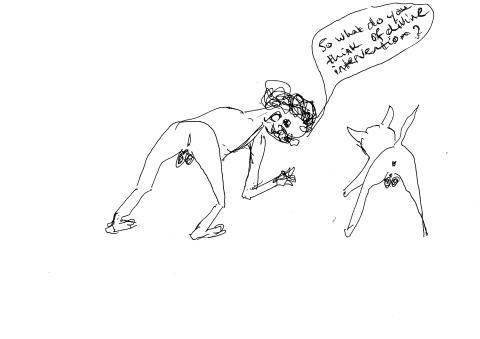
Both are animals, but only one invents the master who'll walk him
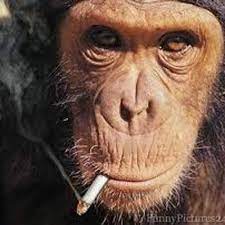
The problem of course is... that existentialism doesn't solve anything either!
I sometimes wished we're all dyslexic atheist philosophers, properly exclaiming that we simply don't believe... in dogs. For the salient question is not how or why life and then make up a tall story when it's all too obvious that we are the last-chance saloon, staying and drinking at the last resort resort, an exotic temporary retreat, every thing else a fat-chance parlour, but why the damn question itself!? Everyone always asking what is the meaning and destiny of man forgetting to love life more than its meaning, but unless you're someone like Kafka and his impossibility of crows, nobody asks what is the meaning and destiny of elks and elephants simply because it's like asking what is the use of elks and elephants, like the pointless cat, except for their extraordinary beauty and grace best left alone. And that man's only meaning is to man himself, with no specific, existential purpose - thus significance - many of the others creatures also having a memory. Like the raven and their ritual, funeral wakes, mourning and crying though otherwise not once looking up to the heavens saying... Hey, Crispin, get that beautiful sky, look at that amazing valley; but only as far as we know as they seem to have no perception or awareness, but also no evil twins that will blindly destroy all that beauty for short-term gain! Whereby we should accept that yes indeed we're those creatures but with not as much distinction between us as we think that we're smart. Human temples, Basilicas or other 'holy' shrines inhabited and ruled by the Robed nothing more than stylized ant hills with spires and ornate out-of-world and out-of-place interiors often including dreary, stained glass but not an ounce of true... humility!
- And where only the most faithful sing: For He's a Holy Good Father, He's a Holy Good Father, which nobody can deny...
But the real difference between us that whereas animals can't... we most certainly don't question enough; including and in particular all those cooked up stories of ours. With which we keep the field uneven, maintaining ourselves as the silly ones we shouldn't be, only smart enough to lock the others up inside a Zoo and what kind of victory is that?! Raising that other immortal question: What exactly is the point of purpose? Is there one? And does real, immediate danger not provide our only close-up, often short-lived 'meaning'? Just as on another level and when standing before a masterpiece we simply shouldn't question it, its beauty or ingenuity understood, self-evident, mystery and answer intertwined!? Ah, to be born inside a revolving puzzle.... So that when it comes to daily existence, yes we must constantly and courageously ask all the pertinent questions with one exception, the last, the final, the ultimate killer, the big WHY! Because those so obsessed with it in a certain sense have they not already mostly stopped living? Our real walking dead, killed not by curiosity but consumed by severe narcissism resulting in greed and brought-on hatred in defense of highly self-serving notions by way of manicured dreams?!
- Notre Appétit-d'être doit surmonter la recherche de la Raison-d'être, the only solution, our only real hope! Forget Ennui, Forget Weltschmerz, Sehnsucht, Schicksal, instead do something commonly useful for people you don't even know to clear your mind!
It's a fact, there has been only one animal to ever tame himself, with time learning how no longer to raid, pillage, and murder to survive but to trade and install traffic lights, yet after this courageous corporal uncaging immediately starting to cage his mind, producing caged thoughts. This animal, soon known as man, simple jumper become ringmaster after breaking loose from the food chain yet spoiling it all both by acting as the visitor who after three days starts to smell like fish in trying to place the entire universe on his minuscule shoulders, in the end unable to accept that sentience essentially changes nothing! In the process accumulating and piling up suffocating wisdom to towering heights by learning to preserve it and permanently pass it on, for contrary to frivolous lore it's not prostitution but philosophy that's our oldest and most painful profession, though certainly not as well paid. And significant the day we discovered we could even invent 'knowledge', and nothing would strike us down. I'm speaking here not of the so-called original sin, but again, of the original lie. Yes, in classical Greek the word philosophy means "love of sophia, knowledge and wisdom", but isn't it a fact we loved it so much that we started manufacturing it? Simultaneously mystifying and sanctifying it as time went by? Received and soon revered wisdom beefed up more than anything to cater to something deep inside our human psyche, namely our extraordinary vanity, our unquenchable thirst for survival, our need for order, but mostly our dual addiction to certainty and the still deeper emotional need to feel wanted? Knowledge manipulated the way a child closes its eyes pretending it's no longer there, temporarily living in a world with which it feels more comfortable, but unlike most grown-ups one from which it wakes up no matter what? The formal study of which the pious investigation of old innuendo, of half-truth and fantastical conjecture with all recent doubt quashed practically before these studies are undertaken, in places where anything new or controversial gets barred?
Ah, yes, again! Aren't simplistic certitudes just wonderful!? Everything conclusive, everything definite, definitive and immutable even if none of this can be found or seen anywhere under the stars. Just close your eyes and mind and simply forge things in the way that you've always managed, plus the Messiah's on his way anyway so you can celebrate him once a week and pop his balloons. Even better if on top of all this you can self-induce some sincerity; though hundreds of mostly man-child soothsayers of the cloth will by tragic example teach you how to fake even this! In other words an excellent variation on the adage No Sex Please, We're British: Absolutely No Doubts or Change, Please, We're Humans! A set of circumstances and states of mind leading directly to official fantasies, dogma, endless theory and the often terrible powers of possessive suggestion and appearance. Raging minds sometimes trying to lead us to very strange places indeed, often and as usual by engaging in multiple, even weirder mental demolition derbies along the way... Including the ever present danger of man turning himself into his own greatest disease, as we found out the hard way after Nuremberg!
What mastery! What control! King of the hill, top of the heap, are we? Yes Sir! Amounting to something but perhaps more like a fantasizing ostrich sticking its head and neck deep into the sand proclaiming it's the Sovereign of the Savannah, forgetting its feathered arse sticks out and subject to laughter or savage attack from unknown quarters. Plus speaking of darkness, unlike the momentary closed eyes of that child - it eventually snapping out of it - what if we had all been born moles, subterraneans, eyeless, yet somehow with the same ingenuity? How would 'knowledge' have evolved? For there is no molecular reason there cannot be intelligent life without the same old exterior reference points. And would we then have 'imagined' light, days, mountains, oceans, still have invented our gods, our Virgins, Messiah, heaven, the heavens, never even having seen daybreak, seen a bloody thing but darkness? Or no eyes, no skies, and so no pies....?
At any rate, for those deriding this playful notion, perhaps they should be more generous, remembering that only the truly free can play freely. Those never guilty of what others have done for centuries, that is... labouring under assumptions and prescribed suppositions a lot. The kind of mental rigidity that led to serious religious and intellectual territorialism, some of it so violent that it places him not far above the hippo, his nationalisms making man earth's disastrous tenant; the earth a quasi-celestial, floating soap bubble as if this isn't already the height of vulnerability, inhabited by the smart/stupid constantly and mindless engaging in cruel life-defeating brinkmanship, eyes forever firmly fixed on chosen truths, brain function whenever possible suspended and detained as opposed to that child's make-believe world. Mind free, not frozen, meandering, generously sharing all its discoveries with other children on the block, though sometimes even kid stuff is objectionable, as if there were no rotten kids...
Don't touch that sky, don't touch that mountain, don't touch that theory, it's Sacred, it's Holy, Grrrr, IT'S OURS..!! Better still, and ultimately individually, IT's MINE, MINE..!!
So let's face it, to a blind man all the world goes naked. Affirming that human perception and intelligence are pretty circumstantial and by definition conditional. So what about wisdom, knowledge's incidental step-child, isn't it also bewilderingly relative, particularly in the additional light of everything written in and around us having been so blatantly self-rigged? Oh dear, does this a sinner make, the refusal to be that submissive, ever following, meek Agnus Dei, often more like God's roasted Lamb? (Thou shalt not eat from the tree of knowledge, Thou shalt stay stupid: Genesis, to which it's proper to respond Sapere Aude: Dare to Know.) Or a positivist and an irascible polemicist? A reductionist? An objectivist? A well-meaning, doubting-Thomas relativist then? And so on, and so on. Well, no, no, no, no and no again because laborers in the sagacity, veneration or dignity trade measure elevated speculation against measured elevated speculation, and what is being attempted here is to remove beautiful irrelevance gently in its entirety from its august but withering plinth. Placing it in the playroom, away from that addiction to deterministic promise --- the battle between reason and desire, between fact and fancy having been uneven far too long.
For hasn't the time come to cease inventing certainties covering that arse? Because I once saw an exhibition of aquarelles produced by Down Syndrome children and they were the most unusual and unimaginably beautiful works of art that I have ever seen. Pointing towards a beguiling world all their own, not one beneath us, but one rivaling ours. And by saying the body perishes and cleverly suggest the spirit is immortal, in other words that death is birth, where in religion and for that matter in philosophy can this hidden Mongaloid world be found? What happens after our chemicals happen to settle into a different mixture and texture, altering gods and playing fields? Do established disciplines really have any idea what such a person sees and feels, presumably no less real to him or her? And will their 'soul' forever carry on this way: if so where will 'it' end up? 'Truth' and 'relevance' only to be found in quantity then, in volume, because fewer of these people at stake? Yes, what and where is more real, decided upon by who, especially when the choice is not between onion soup reality or illusion, but between reality that for one reason or another... is multiple? Anyway, since we're so damn mechanized perhaps one day we'll come up with a reality machine or else bi-focal reality lenses, accurately measuring and determining what's true, real and relevant. Dealing with things like sophistry and its many respectable guises, by implication presenting soothing definitions yet representing mostly suitable nonsense, not much more. Or mysticism, escapism of the highest order, though happily mystics don't murder much. Alchemy and black magic then, treated with contempt these days, but not the rest of the hocus-pocus--- collective rationality somehow stopped half way downroad, turned inside out rolling itself into a ball before kicking itself anywhere it wishes to go. Reason turned surreal, or at least slipped into the skin of irrational notions with way too few noticing or volunteering to admit what's going on.
Most if not all of this evolving in the epoch between Euclid and Copernicus, when we were visited upon by a thousand years of darkness, a time of reason lost when most of the damage was sustained; the birth of insidious tunnel-thinking and intellectual perversion. For the reason Greek and Roman thinkers were such astute theorists was mainly because they were free-thinkers, unburdened by intellectual straight-jackets, checks, dogmatic halls of lousy, broken mirrors, double curtains and traps or having to worry about Christmas coming up, who already surmized the earth must be round, could not be flat, at the center of all and everything in the way that shadows move or simply by looking at the sky with an unbiased naked eye. Though let it be noted that for all their zeal and just like Jefferson many of these boys owned slaves, fabled democracy for them alone, nobody else, without any problem relegating an entire group of humans to permanent, imposed subservience and servitude. As if these other individuals were useful domesticated animals and meaning that they themselves were not all genius but - though healthy, free, fearless, well-adjusted debaters - imperfect, often inconsistent, crude and cruel, not compassionate at all and morally most flawed. But at least daring to explore, people within Amor Fati and in strictly abstract terms believing more in civility at least among 'equals' in 'their' community, than in immortality when after a millennium or more of monotheism and the promise of it all we have to show for are murder, deceit and oppression in massive attempts to corner fluid thought. Whereby - and everything taken care of under some forbidding religious laws - we're permitted to kill others without risking our own eternity; isn't this just peachy and superb?
Even now this persisting twilight, these lingering fogs in so many quarters on this planet - which also includes New-Agers who are already quite mad - or else the truistical notions of Intelligent Design or Directed Creationism in Thermo-underwear as I call it and all of it nothing more than yet another confirmation and comfort job - and all this because of the primal need of these and so many others to have someone or something look after them. Yet all too soon leading to the lethal childishness that under some belief systems allows the dropping of bombs in order to make - if not prove - not only a ridiculous but often such a tragic and fragile point. The incapacity then of some to accept doubt, discovery and natural spontaneity in any shape or form, including the observation of the even smarter part of creation that followed the first chemical explosion of biological life, a continuation called procreation and as far as I'm concerned the real McCoy. The self-perpetuation spark that for a relatively lengthy number of days and over time overrides our personal demise. The true miracle involving the here-and-now business described here at many turns and one we should try so much harder to remain part of not own, resulting in the hard materialism and disharmony of our Boeings and our skyscrapers.
I mean, a primeval soup by some chemical coincidence starting to turn solid and move all by itself is amazing enough, but it jumping out of the pot and beginning to make new little soups is outright astonishing and mesmerizing. Besides producing our first, fine early murderers, also and thereby generating the pheromone sparks that travel unaccompanied towards and seduce a suitable partner sometimes miles away so ensuring they (we) not only endure but extend this explosion we call life. All this through a variety of clever recognition mechanisms harboured inside all plants and pants, though sometimes failing and signalling eventual disappearance still simultaneously managing to preserve natural renewal through sexual desire and that masterful, libidinal bag of tricks. I mean is there anything more ingenious for us humans than a well-timed erection or a pulsating clitoris? I can think of none! And yet some folks remain incapable of open wonder and marvel, addicted to closed-in, ready-made, life-vest theories and explanation accompanied by trusted rituals quickly enforced and augmented by way of threat and terror as in 'holy' punishments. Preposterous, as in the known example of the hung 'witches' of Salem, not the Devil's Brides but condemned by their mental disorder compounded by the Monty Python style deductive reasoning of those even more deranged. Those hordes of accusing, unhesitating male and female Salomés in the wings waiting to roll heads on history's too many dreadful stages...
- True intelligence creates awareness
- The first notion it produces, recognising the self
- The second notion, to ask the self a question
- This question: Why?
- The third notion, finding the answer
- The one immediately implied, pinpointing a purpose
- Man in need of purpose as much as needing a morsel of bread, a gulp of breath
- The difference that he can make the former up, compromising his true intelligence, and a greater tragedy than death
- Off with saviours and amulets
The beauty of open courage, the beauty of randomness, the never ending natural eruption and combustion escaping those making sure that absolutely nothing interferes with their convenient, petrified, arbitrary, crutch creed explanations; and so never ever to be dissuaded, obstinacy always confirming their gratuitous arbitrariness. Because the attempted elimination of certain fixed ideas to them akin to some sort of spiritual lobotomy in the face of which they jump on a white stallion on their ride to obtain a given God's honour through horror, monstrous swords drawn, howling ferociously, fearlessly attacking disagreeing strangers so creating God's insane asylum unless of course insanity is... God! They who claim to believe in God, but only if they're left in charge! No wonder Milton coined this pandemonium and the real hell on earth not so much a Paradise Lost as a Paradise Flopped. Plus speaking of tall tales, it's not dying swans most mourn, it's angels not standing behind a death-bed but inside one, which they won't stand for... Anyway, those who'll get very angry once you state there's no such thing as eternity, so angry that they'll kill you to silence you which again is a total contradiction-in-terms, but what did you expect? When strictly speaking and as bitter irony that by killing in 'His' name one tragically proves that 'He' doesn't exist, in that if 'He' really did.... 'He' simply wouldn't let you...
- Gods don't murder much, people do!
Because we simply can't 'know' it 'all', this savage but beautiful gnosis never to be entirely ours for the equally simple reason that the real, that even a partial truth is both mobile and swift, enormous and short. Yes Veritas Odit Moras, the truth hates delay, yet it still and often remains beyond us and therefore shouldn't beforehand or for very long get copied, caught, bought, contained or domesticated Nor intended for private use as it rises above us like a magnificent but sometimes clouded mountain top, only seen and visited by eagles flying free and high!
Collective delusion making faith so addictive, even to a paleontologist and scientist like Teilhard de Chardin who didn't wrestle with evolution at all, he just backed up the biblical clock and calender a handful of eons so managing to remain a Jesuit priest and cake-eating, fence-sitting creationist, for some evidently the way to anchor down and try to legitimise everything strictly according to their own wishes and hopes. Plus especially Roman Catholicism manifesting underpinnings of erotic connotation not only directed at the Holy Virgin, but as reflected by Bernini's sculpture of Teresa de Avila's total ecstasy on the wonderful occasion of a cherub penetrating her with God's golden rod... But do visit the Santa Maria della Vittoria church in Rome and see the damn thing before you dispute this point, and look at the lush cold marble before you'll note the only thing missing.... on her face a deep and satisfied blush. Sex so much more than the physical, orgasmic, the blind drive of multiplication, at a deeper level confirming, making man feeling not just accepted, but wanted, needed, cared for. With religion, while by itself not in need of man falsely I feel still seen to protect and thereby confirm and so identical to sex making people feel so very wanted and loved. And then of course whoever is wanted and loved must be SAFE? Right? Sex and religion, both strong and completely irrational sentiments sharing an irrepressible desire for belonging, a lair from which and for which many will kill if threatened by eviction. Or else from where to prudishly divert their eyes from what really is the case inside a completely immoral, unsentimental universe. Deep, deep down not so much believing as deliberately ignoring, against their better judgment forcing themselves to join all those front pew denizens as if something within them needs this fixture like one of so many in their pantheon of feelings and thoughts. Followed as always in this human parade - and also naturally - by the more obvious pragmatists and their constant doubt if one is dealing with a dishonest believer or an honest disbeliever, as if in the end - again - it makes a damn difference! But on all scores and for many, many reasons, best for society that both sex and religion get practiced strictly... between four walls, at home, behind closed doors!
- Q: Sir, do you believe?
- A: I do! I do!Yes, indeed!
- Q: Not a just-in-caser?
- A: The very best, I assure you!
- Q: What the hell does that mean?
- A: That it was my firm decision!
- Q: So not a natural believer? Faith a business deal hopefully paying off, including multiple choice morality?
- A: That's a harsh assessment...
- Q: Really?
So that it is just as derisory for the gullible to claim all is well, that we're needed and looked after purely on the basis of ornate fairy tales as it is an extreme form of arrogance shutting all doors to mystery suggesting we already know everything there is to know. In other words we should exclude nothing but believe in very little and as it is almost impossible to speak of certain truths, better just reduce them to likelihoods; or not, of course... Then admit that centuries of mainly self-stroking musings have not been a complete waste, far from it, even though our now dead white males have turned out to be not only quite pale, but quite stale. Their work extremely useful in making ethics systemic as they turned life bearable whereas ire, indignation, envy, greed, disrespect, unreasonable perceptions of shame, fear-induced hatred, retribution and vengeance are all tools... to kill. On one basic level making us understand the structures and mechanics of language, of feelings, of aim of thoughts, never mind the hundreds of immature and juvenile conclusions that in the process were arrived at, were simply moral teething and a necessary part of our growing up. Work, even though radiant considering the primitive times in which they were conceived, never to be taken as an end onto itself. As for instance Spinoza's dozen or so formulae first 'proving' there is a single creator and telling us that God is everything, then in his Ethica concluding that on the contrary, everything is God and thereby to all intent and purposes becoming a free-spirited naturalist atheist nobly turning his back on constructed belief, on constructed meaning. In this respect well ahead of and by a couple of centuries pre-dating Kierkegaard and his 'accompanied' existentialism. One whose inconsistent and disloyal reasoning reeked more of narcissism, relegating everyone and everything to some sort of 'friendship with benefits', including his family, his women, his religion and his philosophy, in a continued attempt by a magnificently depressing Danish fence-sitter to have his cake and eat it, too! Preaching human love while incapable of extending it, unwilling to let go not only of religion's mandates but its pretty yet false comforts; its properties, priorities and proprieties; in other words pieties his apple pie!
- Unlike the prisoner who hours before his execution welcomes the priest sent to his cell to spiritually comfort him with these sardonic words to the cleric: You poor, poor bastard! What can I do for you!?
As is Kant's de facto and 'safely' sticking to some abstract God code, some God-figure, but still called one of our first modern rationalists. For didn't he say that he'd found it necessary to deny knowledge in order to make room for some form of faith, so putting Descartes before the horse? Or closer to home why the canon almost coerces us to put up with people like Sartre, one who agreed with Hume saying the inner self is a delusion, writing that our consciousness resides fully in the outside world, that there is no world apart from the external world, before also declaring that experience can no longer be seen as a process of assimilation in which information is incorporated into a personal body of knowledge. Hello? What kind of idiotic, contradicting nonsense is this? One at the same time maintaining humanism is a condescending bourgeois tool, while he remained in total denial of the inherent tyranny of anti-humanism. Daring to incongruently define individual sovereignty and freedom for us while remaining an unapologetic Stalinist or having the audacity to denigrate freedom delivering America and its allies in order to laud the lunatic keeper of that vast prison called Cuba. A smart French moral charlatan and despite his utterances, and certainly most jealous of Camus, this au-fond-petit-bourgeois smugly approved of revolutionary blood-letting for abstract ideals sitting sipping drinks in a comfortable Paris café. A typical situation of obstinate thinking and erroneous loyalties unsurprisingly leading to concrete betrayals and in the latter's case not only spurious but duplicitous reasoning by the lecherous lover I long ago baptized Jean-Paul Satyr... As with de Beauvoir's political savvy, from the same café in 1939 naively maintaining that all fear of Hitler was grossly exaggerated, then repeat her stunning moral and political insight when it came to Mao 10 years on while condemning Camus' revolt against the concept of bloody revolution... as cowardice! No less!
Of course there's absolutely nothing wrong with authentic, enacted female desire but an iconic feminist claiming the freedom to sexually manipulate like the worst of them mixing existentialism with libertinism is scarcely believable and not the shining, living example of all that she herself wrote. Turning her own Ethics of Ambiguity into the Ambiguity of Ethics, often a second fiddle and night escort composing a tome on female perfection and succeeding admirably on that score, but at the same time remaining many a mandarin's and experimentally a few ladies' lapdog. And still get away with all of this wearing bathing caps in sidewalk cafés, not swimming pools: Zaza, je prendrai un café-au-lit avec toi, mais cette fois-ci pas trop fort... And what about the impenetrable Heildigger, not so much a philsopher as an inventive modern philologist, lowering his antisemitic Bavarian Lederhosen well on his way to getting into wood nymph Hannah's pants after discovering that she wasn't! Unless of course this is the tale of a cool and cunning young Jewish piglet bagging the big bad butcher as a trophy and a below-the-waist career move; who knows...? Either way a man who's not a cosmic thinker but a cosmetic comedian, still taken seriously merely because his massive, deliberately dense liturgy reads like a Jackson Pollock drip painting offering consistent asymmetric depth by the m2 to please professional strivers and snobs. With one big difference in that stepping back from a Pollock work, in particular his Number 21, or Mural, these become unmistakenly beautiful...
Therefore let's just call a spade a spade and brand a lot of this - even if not all of it and all of the time - inconsistent, paradoxical, pretentious intellectual and moral posturing, more than enough to temper our natural urge towards always latent hero-worship often based on borrowed admiration. At least the way today it comes across to ordinary, honest, investigative citizens. As for instance with modern language-based deconstruction theories which, pursued to their extreme lead to a nasty case of decomposition of the mind: ice dancing, figure skating all of it, circles beautifully drawn, exquisite axles and soaring triple toe loops, just about choking the bishop in mid-air and much coveted medals in the end, seeking, seeking perhaps, but always stuck in the same bloody ice rink. Beckett stumbling upon it, in Godot, Lucky's chattering soliloquy to be precise, suggesting that massive words don't constitute more life, deliver more meaning or freedom, necessarily deliver anything. And on yet another level also this simple analogy to ponder: recently Swiss aero-dynamic engineers scientifically 'proved' that it's physically impossible for our dear old bumble-bee... to fly!
But do let's get back to all those notions of time! Time is motion; everything always constantly on the move is the 'human' clock and history not only the tracking and measuring of it, but an attempt at cornering endlessness? In cosmic terms the filling in of distance, but besides all this mostly the mental space in which we move? And at the same 'time' isn't our ontological 'zeit' quite immaterial given that in all our thinking the fatal inhibitor is... our ephemeral fire-fly status? That old three score and ten business disqualifying us from participating in issues of enormity, making much vaunted relativity theories so relative that to us and strictly speaking they become null and void? Lost in the endless waters of space and motion, at least as far as physical man is concerned? And if you disagree, Prof Dr Heinz Zweidrei-Klean and Herr Dr Schneewittchen of the Max Planck Institute of Extra-terrestrial Physics have accepted to investigate my point, but indicate they'll need 1.3 million 'years' to prove or disprove it. Yes, yes, I jest, but don't they? Because in biological terms aren't we mere temporary syntheses? No Travelling Wilburys, but travelling particles and molecules if not amoebas, in cosmic terms somewhat ingenious, electro-chemical flames? Yes, man the flame, with the earth and all of life a slow burning fire. Even the tree, grass or that humble bumble-bee, extensions of an even larger fire until he, they or it burn off. And yes, yes, life the flame does repeat itself, but never by leaving things the way they were, making our conjugation 'is', a very, very relative and tenuous one....
Meaning that in the same way that we must deal with inherited credo much more knowingly, we must equally accept that there are limits to our investigations, our importance and perceptions. That there will always be more than that smallest universe of them all: the space behind our eyes and between our ears. This after looking at images of galaxies that don't care about us and thrust into clusters but reach us by way of 'old' light. That grand irony of something on the surface of things taking place right now, but having been concluded and changed into something entirely different millions of 'our' rotations ago, and so no longer a factual 'truth'. All this to us today a bit of an impractical, nay, futile spectacle at which point it is best to sit down, have a cold beer, relax, and pretend that the rosetta red galaxy seen through our Hubble now James Webb mirror satellite telescope was colored by a squirt of ketchup on its lenses. Yet with this admirable human technology still giving us our first look beyond our own galaxy - and at the creation of creation if you will- also makes us feel even more insignificant and more despondent than before, space the place with neither joy nor laughter and why we invented all those damn gods...
That astonished as we are to find that on another level an atom is in fact another pint-sized universe where protons and neutrons dance and dance to the tune of their quarks, all we can bloody well do is watch and watch, forever the innocent spectator! This a solar system with whirling bodies of its own and our own earth for all we know a proton in an atom in a molecule of some giant leg of lamb, making us the quantum and forcing us to stand back and reflect at levels never contemplated before. Anyway, just to continue this playfulness, what an extraordinary notion, for all we know planets as cells in some sort of unimaginably huge body, with still not much more insight and awareness on our part than any insect has of our earth! Yes, why not, don't insects have a brain since they move? Yet what to do as humans, finding out not only that all matter is concentrated energy, in so many words solidified gas, but that all we are is cosmic petfood to some growling monster, while both arose from it!? I know, it's tough to be insignificant, even worthless, except to ourselves...
At least according to numerous and often contradictory documentaries on the subject that I've watched, though these unintentionally also make it quite clear that in the end there's not much more to argue over than if we're 98% water or 100% gas. And whereby quite mad theoretical astrophysicists - not to be confused with theoretical physicists keeping feet on firm ground - instead of starring (!) in not only perplexing but ultimately terrifying cable TV programs would be so much more useful in an immediate sense by doing community work or better still sell eternal life insurance as they talk a terrific game about the cosmic bubble, that gaseous biosphere, in which we all exist. Unles we were all forced to study astro-physics by indirectly coming to love this earth, think planet not territory, stupidly threatening each other with weapons of mass destruction for totally insignificant, supposed glory. And not not because of what they know or think of as accurate - although, what is accurate - but that regrettably and again all this knowledge ultimately becomes insanely immaterial to biodegradable creatures like us. As when they tell us that Quasars will destroy us, but that without them we wouldn't exist, just like volcanologists not having a clue how or when until they happen to see what we can all see. Or climatologists who don't know what the weather will be like next Tuesday, but tell us what it'll be like a hundred years from now; without their hocus-pocus but precisely and exactly what all our gods in robes do and so thanks for this knowledge, but no thanks! Paleontologist at least teaching us a thing or two about our past, though wait maybe this is unfair for I don't know how many thousands of real theoretical astrophysicists there are in the world, approximately 2000 I'd say, but perhaps we should keep at least 1 of them as nightwatchman over the universe. Or maybe 2, for when the other one goes on holidays, unless of course caught red-handed they all decided to turn over half their current salary to keep envious people like me quiet...
- The intrepid science-scribe Bill Bryson who writes like that other gifted journalist Voltaire, except more humorously, putting it this way: The upshot of all this is that we live in a universe whose age we can't quite compute, surrounded by stars whose distances from us and each other we don't altogether know, filled with matter we can't identify, operating with physical laws whose properties we don't truly understand....
This indeed kind of saying it all, but now something else! We have the good sense of measuring space 'distances' with trips of strips of light as miles and km's are too much of an earth thing. But isn't a year also an earth thing? So what's this obsession with age, the notions of billions of years here, there, when an earth year's nothing but a whole bunch of our planet's spins and turns. Isn't this akin to measuring a tree's age by the number of times a cherry spins and turns in the wind...!? And then that other obsession, the scientific infighting over the earth's weight announced in its own man-made kilos or pounds, measurements based on the strength of things falling down out here (yes, in this case the force of the cherry's downward drag (sounds obscene, doesn't it?) like Newton's apple, but almost like saying... It took 2 seconds to drop 7 meters, therefore the moon weighs 1 trillion kilos!. Then intrepidly continuing to measure other planets' pull or weight with standards only applying here, absolutely nothing universal about them!? And so the point, dear people....!?
Yes I know, I sound a little exasperated but I'm also having fun, which is my point! Still, it's time for us to realize that only looking at particles not at ourselves is beginning to understand the universe as one enigmatic placenta - expanding or not, and then towards and into what exactly; or... just about to burst and then what? - ; making the cosmos just another womb. However even with all this knowledge, this small degree of insight we obtained through our human intellect and inate curiosity mustn't we also accept that we can never escape our guilded prison and will always suffer the cruel, tragic facts and fate as presented to us, making all continuing studies in this direction ultimately pointless? That our 'playing with and inside this area though all too human, not uninteresting and not particularly effective, in the end mainly reflecting an only in itself remarkable but still highly uneven, volatile, distorting and too often self-defeating mindscape? Whereby those Big Bang or 'unifying' String theories should not become obsessions in that there could be many space bangs, ripples, folds, strands or fusions beyond our mental range; the fifth essence or the unknowable dimensions as they're called requiring a totally new, a seventh sense. Beginning with the idea that presumably there is a method to the cosmic chaos, given that not all chaos is madness and like beautiful free-dance could still be loosely organized. And that, again, while not having to give up all exploration which is in our blood, man has to remain much, much more philosophical in the truest, purest sense of the word: above all no dogma or doctrine or creed at the end of which particularly forbidding, supposedly 'wise' men wish to establish moral superiority with a little mass murder and mayhem in what is a pretty childish quest for that double whammy of the song that goes: Nice work if you can get it and you can get it if you try: in this case, of course... power accompanied by immortality! Man, while basically intelligent still all too often caught up in what can only be described as attitudinal and therefore silly, acquired stupidity, the self-deprivation of any sort of wider grasp.
- I don't trust atoms, like man they make up everything...
All of it very well and sometimes entertaining, though what does it all really matter when there's every possibility the human species itself might have disappeared or been eclipsed in say 20.000, 30.000 years in the way that strains of insects were found frozen in time and inside droplets of primordial amber? Man the new fossil sooner than he thinks, our current collective umbilical cord already stretched to roughly 200.000 years, isn't it going to snap at one point? There being only so much genetic mileage to be extracted from the overly complex human mammal, plus given that as organised societies we've been around a scant 8000 'years' (with our very limited perspective branding the first of these as existing in 'antiquity', though happily one historian when asked what influence Christianity's conquest of the Roman Empire had exercised on modern western society retorted that it was much too recent a situation for him to comment on!), and yet not organised enough to suspend the irresponsible depletion, the outright plundering of our planet when looking at its diseased atmosphere, oceans and forests, its festering coastlines?
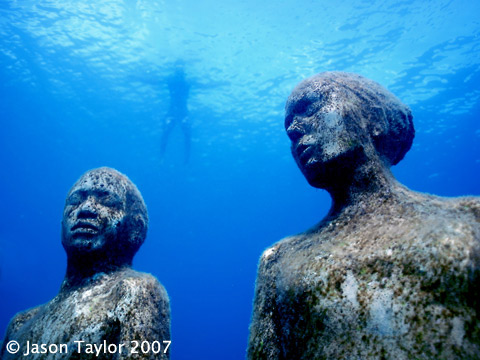
(Image provided by the magnificent young sculptor and sub aqua artist Jason de Caires Taylor, see Jason Taylor )
Which road to oblivion? Of course it can be argued that there's nothing to worry about, that nothing disappears in thin air, the earth 'forever' feeding on itself in the way that forests live on their own fallen leaves, branches and trunks, over the ages pumping up hundreds of thousands of tons of oxygen each day, the very atmosphere and topsoil covering otherwise inhospitable rock. But then also consider that we may be too clever to survive, humanity not that forest, contrary to general belief only one among its many branches, one becoming way too heavy for its own good and ready to break at any moment. And yes, after we die returning to that marvellous rotating system that produced us, not offered an afterlife as much as an after-existence. One day materially showing up likely not as a beautiful eagle or gorgeous little sapling, but as the 'un-being' but functional and still useful steering wheel of a Ford Mustang. And why perhaps it gets called incarnation... thus all the way from driving one becoming one; full circle! Morning Gramps, how are the molecules? Got enough oil?
- Let's never forget that atomic clocks are us, that man can be nothing but biodegradable thus best before expiry date!
Dead serious once more and put quite differently, if we're not careful humanity found hanging from its own family tree having become its own waste. Done in by natural factors which include itself, the sad case of not only a vanishing Paradise, but of Omphalos lost... Man Lost! Even all stars eventually done-in, including our sun, yet upon some unforeseen genetic renewal still allowed to start another life cycle. Us on a biologically active (either this, or having to bring sandwiches?) exo-planet under a slower burning, protective Red Dwarf, not as hot but just as effective apparently as our sun ever was for us. Our last hope then, but that's the stuff of documentaries for what's in a cosmic trillion years, except for all its meaning for us nothing apparently but... meaninglessness!? Therefore I certainly won't let it interfere with my morning croissant and jus-d'orange and still only represents a potential stay of execution seeing how we constantly foul the magnificent terrestial incubator.
On the other hand here's an idea, how about shooting all our horrible plastic and other waste to some barren moon? (Not only Blue Moon You Saw Me Standing Alone, but one where the Rocquefort leftovers went?) We can already do all this, and unlike down here up there plenty of space it appears!? Or was this already done, that we're sitting on someone else's waste, we the maggots riding bikes, planes, and trains? Unless, our turn come and much more nobly, we decided to arrive as a pollen instead of as a virus, at long last leaving behind petty, stupid, cruel, national notions where they first saw light. Come to pollinate and bloom rather than infect, but despite all our missteps and utter failings that most marvelous thing of all: deserving it or not still apparently getting this final choice to make! One not to get screwed up through deadly narrow-mindedness by way of one-dimensionality, either way on some hopefully very, very distant day bequeathing ghostly piles of vine-covered rubble, formerly known as New York City, Cairo, Shanghai: Angkor Wat on the Hudson, the Nile, the Yangtze. Though for the time being still having to forget about walking our dog along the Milky Way or open a bar on Mars (Ah, yes, those Mars bars, but what a lousy atmosphere...), today everyone fighting over how it all began, biological evolution or divine creation, but few daring to ask how it'll all end. And not apocalyptic claptrap this, only that at the very least and at one point there'll follow an organic scaling down, a drastic planetary housekeeping of Permian or Cretaceous proportion probably followed by a whole new Cambrian explosion and not because anyone says so, but because of the way things clearly work. The spontaneous chemical seasons of all matter, everything chemical, everything always on the move and fermenting, the majestic but unequivocal seasons of being. That, mutatis mutandis, constant molecular processing and being processed are the only way delicious life can exist and thrive in spurts. I mean we excrete, so is there any point in thinking that somehow we're above it, superior or chosen? Even our social and political forces representing a mitosis of a kind, the constant, organic splitting of 'cells' and 'thought' followed by new formations all the time, at least in true democracies!
With this I mean let's move away from sophisticated but fearing sentimentalism, at last injecting some courageous pragmatism and realism. Because when two of among millions of galaxies collide, events taking tens of millions of our years to culminate, how then can Jesuits, Jews, Salafists, Sikhs and so many other gentlemen for instance, still now today really, really believe that this is all with them in mind? And speaking of being of one mind, but of two worlds... I once saw a hasidic chap praying standing up with his nose close against the wall in the corner of a crowded Paris Air France's First Class lounge prior to boarding a plane to Montreal, no one knowing what exactly he was hoping for, but everyone reasonably certain that it excluded the rest of us! Or else the Party of God of some, with an Army of God which is as preposterous and funny as a Party of Tinkerbell if it weren't so devastatingly tragic, in fact godlessly professsing profound belief... in Kalashnikovs! This in their defence of creeds auto-proclaimed as 'of peace' but in reality featuring a paradise on earth that has little to do with spiritual rapture as much as with raw, naked attempts at domination. And so prized properties defended to the teeth by all violent means especially when daring to ignore, disagree, disobey or simply look the wrong way, at which time one gets blown to some other kingdom come... Blind faith as part and parcel of a political agenda and thus not 'blind' at all but 'planned', yet also for so many simply and in real terms a malady called 'self-celebration', linked to 'petrified conviction' or acute 'dogmatitis' followed by 'worshipitis', the daily fix of delusion all too often no longer played out as symbolic pantomime or as metaphors, but as a perfect herd cult. Resulting in becoming some sort of enduring pandemic covering entire parts of the globe, places where dilemmas don't exist; again and again everything approved, most certain and deadly enforced!
Or is all of this simply fear of 'boire la mer'? Man innately terrorised by endlessness and uncertainty, enclosing himself in cocoons which when looking at Tarantula Nebula and other galaxies is sort of understandable. Except for the fact that man's belief-cocoons represent virtual traps only loaded with scented fragrancies that once broken open flee into some rocky flight only to search for yet another cocoon, unforgivably insisting to fill that endlessness with nothing but endless factual emptiness! Wherein his convictions and beliefs, yes, his cocoon! His very personal struggle in dealing with the clash between mortality and infinity so acute that man must set boundaries, shores, respite, by way of made-up answers as buoys! A fear of drowning before the swimming has begun, akin to an airplane pilot in combat with vacuity beforehand setting an artificial horizon, so he won't crash!
(Lion to Lioness, peering over the Maasai Mara veldt)- What the hell is that....!!!???
(Her, spotting a Wildebeest with a long, black beard)- I think it's an orthodox Gnu!!
(Him, puzzled, laughing)- No kidding! What else is Gnu...!
(Her)- It doesn't matter, does it? He's different and cute!
(Him)- But only if he knows he's from this Kingdom, just like that Acacia or Bilabab tree over there!
(Her) - So one of us, no matter what?
(Elephant) - I'm all ears...
(Him)- But convictions being what they are... likely a more difficult task!
(Elephant) - I'm all ears...
(Her)- What are you saying, that Super-Gnu's not in the stars?
(Him)- Yup! So stop Gnu-flecting!
(Her)- I only genuflect and bow before you!
(Him)- Pulling my leg when you do?
(Elephant) - Now we're talking....
But how did we get from early Neanderthals to be the forever favourites of whatever gods, inventing the necessary words, images and matching symbols to shore them up? Creed, ethnic origin, traditions and institutions, the eminent Dr Lévi-Strauss tells us, a by-product of a world that started without us and one day will end already without us. Einstein in his 'God' letter, rightly I feel, acknowledging as much. A place where despite appearances, and without any disrespect to anyone, we all did come from the same stardust and like it or not end up in the same cosmic cauldron. So that for now and on the purely physical level let's at least realise that tectonic plates and all their seismic activity are still capable of keeping the world's crust slowly but violently on the move. That a small planetary wobble can make all mammals including man extinct, that volcanic ash-induced ice ages covering continents with hundreds of meters of unliveable deep frost are not a thing of the past; in short that life and the earth have not stopped evolving now that we're here. That whale skulls and enormous jawbones have been found high up in the Peruvian Andes and that pink salt is mined in the Himalayas which only means one thing, and that is that these majestic mountains were extended seabed at one time. Or else that hyena fossils have been found high up in the Canadian arctic indicating that these lands weren't so arctic at a certain point in time. And that lush northern Africa covered with savannahs and lakes turned into the burning Sahara less than 12 000 years ago, with fossils of giant sharks, sawfish and electric rays dating back 50 millions years getting dug up in what today is the Libyan desert and deadly dry, barren Mali. Oh and not to forget that the Horn of Africa is breaking away from the rest of the continent as we speak... Plus that what is currently known as the Black Sea was once a low lying sweet water inland lake with sophisticated Thracian settlements at its shores predating the Egyptian Pyramids by at least 2000 years. Tribes suddenly finding themselves swept away at the receiving end of a huge Mediterranean salt water flood, after the fact and much later described as being of 'biblical' proportion, originating at the Bosporus after glaciers and ice caps at the top of the earth had melted to substantially raise sea levels during epochs of extreme global warming.
When earlier none of this had anything to do with human activity or divine punishment, now XXI Century man and his prize architecture so damn sure of himself and 'his' world that he foolishly erects thousands of glass and concrete towers smack at the edges of oceans and water levels that at one point are apt to dramatically rise with special thanks to the accelerated climate change he also unhelpfully provoked. (Head for the hills...) Whereby it behooves him to stop cutting down trees and bloody well clean up his plastics and industrial act, greenhouse periods already forming part of planetary seasons making that we'll always only be the flame that jumped into the flambé pan, that off-spring of light, that spark in boots, in trousers and skirts, that short wild dance in the universe together with our bosom friends, those superb plants and their amazing structure, those wonderful insects and those sometimes bizarre looking striped, spotted, hoofed, pawed, clawed, scaled, horned, finned, furred or feathered cousins of ours. A ball, a dance, too crazy, too magnificent to end until the fires die, only to spring up elsewhere in that long, long night... likely with entirely new music to dance to and starring unrecognizable creatures and crops, maybe not killing each other with microscopic precision like all of us on earth do...
We for the moment the third force, situated between solar and volcanic activity arriving from the earth's molten core that can hurt us, yes, of course, Krakatoa, Vesuvius and all that, but also repelling the pervasive cosmic radiation that would otherwise kill us every hour of the day by providing that magnetic shield making all prolonged life - science tells us - possible in the first place. Meaning that we're protected only until these very fires through core exhaustion and solidification or else some sort of collision decide to alter everything, and we're not so quietly asked to dematerialise. Adaptation by disappearance as it's called and also referred to as the evolution of extinction. Unless of course we did manage to get away, circling a new sun/star by way of moon, asteroid or planet hopping, a long-distance yellow cab. But NONE of these aspects adequately reflected in contemporary philosophical treatises and dissertations having come to public attention, still carefully looking inward and the other way, building outmoded thought on outmoded thought only for completely adrift academic purposes. In which open philosophical search no longer seems to take place, parasitical positions firmly re-taken from 9 to 5, all subsequent energy getting wasted in defense of them. With abstruseness sometimes bordering the perverse lacking any link to people's lives, as if the word 'new' itself anathema, with the cultural divide between science and the contemplative humanities a case of two solitudes. As for the rest, this has nothing to do with the quality of our thinkers and the way that they stood out in their day, but over the centuries and even now out of some sort of obedience arbitrarily applying what is commonly called premature closure, truncated reasoning likened by me to serious intellectual coitus interruptus. Through convention compartmentalised or ideologically lobotomised man not only carefully painting, but feeling and thinking by the numbers of their epoch. Constructing sometimes admirable yet by now incomplete thought, dismissive of the idea that what is required at this point is not more mental spinning... but more courage and a minimum degree of metaphysical defiance.
Yes, slow, essential change making all things tick, is assuming that we can stop and linger, hang on, always bloody hanging on, implying we're above change not part and parcel of it not a little silly or worse: the height of egregious attempted, organised consolidation? For what are these 20.000 or 30.000 man years anyway but a quick drop in the ocean of cosmic 'matter/time/space', organic or not, in a place where in human terms when all is said and done and except for brief but enormous and violent outbursts, nothing much takes place? Not inherently of course, but because of our abysmally limited perspective, that severely curtailed and therefore insignificant presence. We, sadly, the universe's ephemeral, marginal and totally immaterial witnesses? Making that even should we be the universe's prize biological trophy, we by implication also represent its failure. This by letting us escape that lousy but necessary food chain - not just a Darwinian dinner arrangement but meant to control numbers - that there weren't supposed to be 7 billions of us so that by breaking it in order not to get eaten we're now well on the way to killing ourselves! And the reverse side of the coin though still ambushed by unexpected viral pandemics that help speed up our own repeated, sordid games, the one of self-destruction...
I know, die we do and strictly biologically speaking die we must, but by giving the good and the strong a couple more centuries of life like the Greenland shark we would at least get to live down our errors and in the end avoid so much man-made tragedy and grief. The case of smart not random evolution, even though there are dangers of our own making in this again, and I'm thinking in terms of equally lengthy deadly dictatorships. Human minds then, so fragile, capable of grasping the ages but in an immediate searing physical sense remaining brutally temporary, and in the end to what avail... For sorry folks, we just can't think our way out of this thing! We the brilliant electro-chemical soapbells floating under a prophylactic sky, below hair and Borsellinos built to burst way too soon forced to contemplate our own stool in order to bring us down a notch or more, perhaps.... On the other hand, as bubbles go, there's no great champagne without them, so that ostensibly we do perhaps, somewhere, somehow, still play an extremely minuscule role as long as we preserve ourselves in the Dom Perignon bottle and that bottle will stay whole! For isn't one bundled up bundle of cells throwing a piece of rubber at another conglomeration of molecules that picks it up and brings it right back not an extraordinary, loving cosmic spectacle? Oh, sorry, that was my neighbour Henry walking his dog.
However, let's not start this borrowed awe again, in awe of awe over-indulging in rampant fantasy at the same time exaggerating how clever and significant all those famous predecessors of ours were. On whose shoulders it is said we stand and who made us what we are today, as if in aviation terms by reading up on da Vinci and his fantastical flying machines is what ultimately got us to the moon; the constant scraping of the bottom of the barrel by those who might as well say there would be no Neil Armstrong without Columbus crossing the Atlantic and so overly disposed towards simplistic deference and adoration. Over-doing and re-doing that think-thing, rehearsed and rehearsing just as they were told... and told... and told, but in the end not much more than intimidated history readers incapable of auto-generated, cogent thought.
With all due respect, what we as fire-flies ought to consider perhaps is turn A Brief History of Time into A Timely History of Briefs and String Theory, that Phantom of the Cosmic Opera, into as many as Bach's Air on a G-String melodies as possible: precisely the down to earth joy that's missing from most 'traditional' thought, except perhaps for Socrates suggesting that a personal life in itself left unexamined to the fullest is not worth living: examined he said, not crafted, not constructed, not fabricated, manicured, not devised, in complete denial of the natural world! Because, putting it like Duke Ellington, And a One, and a Two and a One more Time, beside the real but perhaps impractical, however elegantly dreaming up the rest is not the same. In fact it can be damned dishonest and no longer acceptable, like making up the news.
The significance of most pioneering Greek and Roman poets, playwrights and philosophers therefore of a purely historical nature, nothing else. With Pliny the Elder already rejecting the mad idea that private lives get renewed by our death after he witnessed innocent Pompeii's total, utter, wanton destruction. Or Lucretius and before him Aeschylus and Pindar speaking splendidly and freely well before the slow thousand year murder of uninhibited thought. Only eventually to be followed by folks like Kant, Hegel, Hume, Rousseau, Schopenhauer and his porcupine parable and evidently one of these creatures himself; today all this work of great interest, but strictly for historians and proper thoughtless nerds. After close reading all inherited thought to be affectionately put aside, and superseded by our own determinations unless they really, really, still coincide. Especially Wittgenstein's maintaining that all our answers lie in language, seems like an obsession with the arrow, not with its path. Or that there cannot be absolute truth as mathematics are unable to prove this, the so-called incompleteness theorem. With it dawning on Gödel and many others that mathematics are imperfect and finite in their capacity to embrace all of reality for the simple reason that not all reality is logical or rational by linear human standards, but random and fluid, a chameleon, nearly impossible to define, draw or trap. The Stoics by way of the Cynics coming closest to understanding what life really has to offer by asking us to face truths without preaching resignation, in other words accept life tacitly and as such perhaps best be called the Tacits. Though even these guys still far too self-centered for a world by definition needing to be shared, despite once in a while looking over their shoulders concluding that only a good man or woman can be wise. Whereby wise means generous of course, and not always their case. But who is perfect, besides you and I?
Or else Erasmus of Rotterdam, already showing us how difficult it is to become and remain a humanist, while exposing many of man's ugly faces in In Praise of Folly. A work so earnest it must have been close to heresy in its day, a hay-day of frozen, artificial truths. He an anti-philosopher really, who to his credit rejected silly, arid, punctilious rationale in favour of passion---a measured dose of sweet madness and playfulness. A man who hated people remembering and obeying what they heard, wishing for them to clap their hands, live and drink lustily as excellent disciples of folly. Not bad for a fifteenth century chap, traveling on a mule who didn't take himself all that seriously, but who was unable to separate himself from the Church. But how could he during the time that Rome had a suffocating, totalitarian hold over every aspect of life? And what about Nietzsche, not an arrogant Nihilist as some suggest, one who by rejecting all purpose and value at the same time didn't place himself himself above it all, but acted as an unsentimental Be-ist, as an honest Über-Realist, that's all! For an honest, self-respecting Nihilist shouldn't even believe in himself and so not Nietzsche's problem, though he had many existential issues like so many of us! He the non-conformist following those first, hesitant earlier exponents of the Buddhism-inspired Enlightenment, but the first to finally openly break the mould, that hold of a priori divine presence over nearly all traditional western thinking and not so much killing Him but relegating God to history; you can't kill Mickey either so in a sense only saying 'You're fired! Now Go Back To Your Pages!' Yet in the end spoiling things with incoherent, syphilitic twaddle, already losing the plot before getting hit by that horse in Turin, but a philosopher who had only wanted man to be strong, not pathetic, independent, free at the expense of no one, and a notion I fully subscribe to. Though at the same time a somewhat pessimistic, self-contradictory chap, and as such an aphorist for all seasons, capable of paradoxically opposing all evil and all good. In the end without any consistent line of thought, never quite having expressed that profound, temporal joy unlike vulgar, shallow hedonistic stuff is our only meaning probably because in his humourless personal life he hadn't run into much. A man detesting all religions for being Utopian and playing up to our weakest impulses, yet not blushing to reinvent an ancient prophet for his postulations with the ridiculous, gospel structured Thus Spake Zarathustra! In which he attempts to mortally and morally replace not undo God, only banish Him but not immediately appreciating that man first creating God then trying to emulate and even replace Him may well turn into the ridiculous spectacle of a dog furiously, circularly chasing its own tail...
So that, yes, all of this as if we really have a choice, for beside all that mostly and mainly abusive and abused fantasy would the only other option not be some sort of existential paralysis, the ultimate mal d'être, only leading to group demise? Still, these men and so many others made an indisputable but very brief and transitory contribution to our development as speaking, seeing, feeling and acting beings, if anything by showing us sometimes rather unintentionally how better, or how, at this point in time, no longer to proceed because of what we now know and they did not. The new realities which are not 'new' at all, replacing old ones so sadly contrived. We, the blessed, through truly enlightening, break-through investigation (from Galileo and Newton, from deep time geologist Hutton onto Darwin, Einstein, Watson and Planck, from particle physics, paleo-anthropology, DNA and modern evolutionary molecular/cellular biology, to the origin world of vital photosynthesis, neutrinos, isotopes, bosons, fermions, photons, dark matter, black hole evaporation, dark energy, dark gravity, gravity's waves and so on) as total laymen and men in the street finally able to assess on their own. No longer in need of primitive impulses, of awkward philosophical theory or religious doctrine. Free, free at last. No more beautiful bullshit that once saw us through but also kept us down. At last able to stand back and really contemplate our common, limited, yet quite fascinating destiny with unfettered appreciation. People who beg to differ by placing mind over myth and matter over mind, even when this cuts our own species down to size, to regain the natural sense of awe and joy we nearly lost through intimidation and petrified, but purely cosmetic artificiality.
- C'mon, if God had been really smart He would have foregone the pyramids, the plagues, the pogroms, the revolutions, millennia of unbearable human suffering, from day one getting us all a condo, that Honda, a pension and a dental plan plus season tickets to the Cirque du Soleil...
As for morals, it is clear by now that tolerance and justice are entirely linked to developed intelligence, the lack of it, coarse primitivity, producing inequity and unspeakable social cruelty. That all known gods were born after our civilizations formed so that religion is derived from innate morality and not the other way round, and by which it conversely follows that brutal cultures have such brutal faiths. Marking the arrival of the saddest irony of all, what the French call ensauvagement, the spectacle of arrested thought turning man back into beast, his creeds incorporating his most horrible attributes and defeats and nothing but a lousy mirror, never his liberating victories. The observation that sense takes centuries to become common and moral evolution in so many quarters stopped dead in its track. Anyway, nature as a whole merciless, undemocratic and amoral, only man potentially considerate for the simple reason that while it takes two to be decent, in the long run and pragmatically speaking, empathy and tolerance make such eminent personal 'common' sense. With the purest and noblest among us precisely those whose generosity comes without some held out or 'divine' reward. Our real saints secular souls, unheralded, unpaid, invisible, remaining completely anonymous while others appropriate religion and go to Calcutta to elevate themselves, as if there can be no goodness without the holy Muppet Show. That circus of robes and screens of incense - to fool the devil, you must understand - or should we call it laughing gas as on so many it seems to have a similar effect?
Q: Honk for Harvey, the huge, white rabbit? Honk for Micky? All existing, dying for our sins!?
A: What sins?
Q: Where to find Jimmy Stewart's or even Disney's heaven?
A: According to Mister Magoo and bugsbunnyologists... Over there! Third one on the left, a theater staying open every night and all day long!
Q: Does Thomas Cook fly there?
A: Of course! They all will!
Q: Picking us up at the nearest bus stop or at the entrance of the us-only cemetery, and Main?
A: Never failing!
Q: But how would we get there?
A: By imagining it! The way you deal with everything!
Upon his return from space an astronaut having looked back down or up at us said he saw no disease, no wars, no cars, that it was beautiful! One of us, one of ours, not particularly rueful about finding neither Heaven nor Hell and seeing no Christian or other people's space/time cruiseships sailing around including any sign of the millions upon millions who passed through life before us, waving, anxiously waiting for us to join them on their decks. And so no lunch with Columbus, barbeque with Neanderthals or thanking the much plagued Pharaoh for finally letting the Hebrew slaves go; all of this - Cm'on, Really? - too ridiculous for words! Though he did miss seeing you and me roasting on the beach and wished us well knowing that we were there. Beautifully alive on that blessed, self-contained, brave, blue heavenly body circling an amazing mass of light and warmth when seen up close, but a humiliating micro-pixel when spotted from as little as 100 million miles removed! Is this therefore not the moment to accept the magnificence of life on its own unique terms for perhaps only the second time; first so innocently, in the very, very beginning, and again only of late? Without the intervening interference of sanctimony, of artificial despair, silly threats of damnation, the torments of a sulfurous hell, the fire, the brimstone of it, the deliberate perdition of it, places where even seraphs fear to tread, but where fools thrive? Without the feeble crutch of tailor-made yet devastating eternity promises filled with bored-stiff angels, sainthood and all its supporting drama, dogma, and rites celebrating a goodbye-see-you-later kind of God. Without feeling that for us, here, there's no grand role left to play, that we have lost our meaning, as if we ever really had one or for that matter really need one!? Not as übermensch, superman, but simply as superSchmidt, superLopez or superJones. Man whose only greatness lies in his courage to face and manage if not completely influence his own destiny, one no longer in need of fictitious heroes and so grown up at last?
For haven't we put far too much capital in the search of lofty exterior 'meaning' and capital P 'Purpose' without which, it has been suggested, we cannot live? When the opposite is true, that what's uniquely important in a human life is every day purpose and reason; remove it and immediately see suicide rates begin to rise. No illusions...? No nothing...! Native American self-decimation the horrible example of it, deaths from pointlessness as these could be described, no longer hunting hanging out in and around supermarkets and bars. And even in the unlikely event that there exists an organised power some place high, must we then really think of it in terms of it 'revealing' itself by way of sainted comic-strips given the abject cruelty it constantly displays, not once really protective or loving!? But then again how could it - let's get real for once - yet still courted with naive worship, this ignoble form of begging on knees for forgivenness when normally speaking we're guilty of absolutely nothing? This search for relief in prayer only exposing often gratuitous despair and in reality no different from an ultimately irrelevant Cherokee rain or sundance? Myth and hymn coincidentally and symbiotically connected by that terrible WHY question again and again? Accompanied by singing of deadly - mainly white - Songs of Praise or as some will have it the dabbing of Psalm Oil? All of it ultimately meaningless only reflecting man's highly personal hopes, needs and fears and which if I were He and existed would not only bore me stiff, but would really piss me off? Te Deum tedium... as it ought to be called! For isn't there something inherently wrong when we beseech the guy who created us and presumably put us here to please not kill us when we've done no wrong? And is there anything more incongruous and even masochistic than someone pleading with his own belief not to abandon him, those Gathsemane moments of some? Or anything more pathetic than singing Erbarme Dich, Mein Gott..., Have Mercy On Us, My God..., Miserere Mei, Deus...the listening to sterile, emasculated priestly Gregorian or Carthusian chant imploring that tricky sadistic hypnotist up there for who cares... what!? The great invisible one, created by way of our very own fantasies and lore? But then again, the wildlife in our huge National Parks doesn't know this, they think they'e free just like we do...
A Scene from God's Existence Lab...
- Lord!?
- Yes, yes, what is it?
- Lord, I have bad news!
- Well, what is it?
- It seems, m'Lud, that we have intelligence on earth!
- Oh, SHIT! How did that happen?
- I don't know, m'Lud! An accident, plus they managed somehow to come down from the trees....
- Oh, no! So now what?
- I don't know, m'Lud! Search for an answer... meantime... at least pretend you care!
- Why?
- Or they'll fear you set them up!
- No, I didn't! I have better things to do, not just some Master of Ceremonies. And you said it, it was accident! So next time, let's be more careful!
- Next time, m'Lud?
- And only if these prove that they're worth it...
- It doesn't look that way! Too many morons and arseholes ruining everything!
- But asymptomatic, right?
- As always! They hide it beautifully...
- Come all ye sons of bitches? Then why do I have to pretend anything?
- I know, it's disconcerting! Some even accuse you of creating insanity when it was their own insanity that created you in their own bloody image!
- No matter what I did, do, or did or do not do? So that I might as well not exist at all... And I do exist, don't I?
- Sure, but just in case... force them to PROVE it!
- In case of what? This is getting very confusing! I had more fun forging zebras and tigers and spiders!
- And I do love all those stripes you use...
- I only copy my wallpaper, you dope!
Man refusing to accept that he's a small part of an organic 'whole', placing himself above the fray, thinking the planet is at his entire disposal but still seeking confirmation, as if trying to book an airplane and performing what amounts to an Apache and Navajo rain dance below stained glass in order to get on. Celebrations on occasion totally superseded by self-hypnotics, the ecstasy, the rapture and delirium of Lima's Rose and the Hildegard von Bingen brand and as such not much different from Haitian, Cuban and Brazilean pagan voodoo and Santeria rites, although it is presumed that the second of these exalted, exulting ladies besides being quite unbalanced suffered from epilepsy as well; quite the cocktail back then. And yet all of it deprived of the overwhelming sincerity and raw joy, the explosion of Black American Gospel singing and something that nobody should ever take away from these good folks. Letting them be, for once letting transporting joy be, this their triumph over cruel daily personal suffering and rejection. Instead of that other earlier morbid, depressing, oppressive solemnity and even when witnessing their deep pathos and profoundly admiring the expression not necessarily sharing the substance behind all that exuberance. In my personal case a Hosanna in theatrical and musical fairy tales not involving the King of Glory as much as Hakuna Matata, something like... the Lion King! And all of this reminding me of one Peter O'Toole, in my books one of our finest philosophers whose favorite greasy, wine and whiskey stained jacket could no longer be cleaned and sent back to him with a Dry Cleaner's note saying Item Returned To Owner In Unimproved State, a wording he so much loved that he decided he would use it on his tombstone... And why not? For if so many of us behave like pets or worse like real slaves, perhaps these should no longer speak of their Maker, but of their Owner! And through this lively anecdote only to say that yes self-deprecation and humility are fine, but begging and self-humiliation are not.
For don't we need total self-esteem to achieve the highest degree of universal decency on our own as our final victory over evil and the dark side of human nature? Embracing the often delicious centrifugal forces of existence with the moral equality that the world needs most? Wherein we're our own 'meaning', the striving for the one and only victory in our lives that really counts not a moral instead of all those pyrrhic ones? For there's absolutely nothing that we can do except become fewer, better people; now explain this to the convinced vile! Besides, what happened to genuine dignity? Don't we know by now? Shouldn't we? And dog-fighting or arguing over the above or not, the point having arrived wherein exponential personal growth rather than incessant inference or mere glib phrase-making needs to be the game! Remaining supremely pragmatic at all times instead of incongruously turning abstract philosophy or even modern science and technology accompanied by their brand new mythologies into some crypto-religion, all over! With holier than thou hierarchies accommodating classical, very comfortable power-seekers aided by the usual suspects, those habitual acolytes and sycophants as new Jesuits. Forgetting like always that scientifically speaking we still do not really understand the extraordinary double birth through metamorphosis of caterpillar and butterfly, of tadpole and frog, man incapable of concocting an organic capsule from which under a hot lamp and pouring some water over it a beautiful rose or strawberry will grow. Or for that matter, and to hell with Fabergé, by himself create an egg that actually works...!
And isn't it equally disturbing to note how crowds knowing so much about divinity and philosophy care so little about being truly philosophical? That only earnest enquiry and the inevitable victory of real knowledge over subjective pontification can lead us to victory over our lingering cowardice, testify in favour of our ultimate maturity, our final peace! And just as it is foolish to truncate forward-going reasoning the same applies to those only dreaming in name, for friends, devout believers - and if not devout certainly devoted - if you must, why not entertain the notion that He struggles to keep it all together. That like most of us and with the best of intentions, sometimes moody, sometimes irrational, sometimes forgetful, He miserably fails sometimes with so few giving Him a helping hand, holding Him hostage to every bloody word He ever supposedly wrote. That when all is said and done, He's so Human... Rather than that perfect but Inhuman God waiting to get us, a sort of sadist to boot. I mean, never tired of believing, never giving up, once you do can't you go all the way, believe anything you want, owners of all that glorious devotion? For why shackle yourselves and when dreaming, not dream all out... to guilt free, proud, here-here-land? Or is this already too rational? But if you won't be rational, will you at least not be unreasonable? Or too practical, like that young American I read about, a matter-of-fact believer, praying year after year for the Lord to give him a new bike and never receiving one, concluding that stealing one and asking for forgiveness worked far better. Signifying that bespoke dreaming is what we get, apt reveries, featuring a convenient, tailor-made God. And the philosophical and religious lead-up to it only exposing pettiness, a tragic lack of humour and imagination and all too often the deep absence of true understanding; restrictions all sanctioned by long dead, once shining yet understandably era-confined minds.
All this over and over again only to say that if one really must believe that there may be something in adoring the deities of the polytheist pantheon of restless gods of yore... With Jesus as Zeus, even sounding the same, giving this lonely saviour some subordinates; not only familiar Greek and Roman pals but also the even more exotic hybrid Hindu Ganesh man-elephant, the Egyptian Anubis man-jackal, the Aztec Quetzalcoatl man-serpent, or the femme fatale temptress-songbird Sirens, not to forget fish-tail Mermaids, all pointing at a playful, folk origin rather than 'revelation'. And why by their very number it becomes clear that contrived out of innate existential fear driven by cognition, none can possibly exist. That it amounts to a Stockholm Syndrome; later by attempted out-believing turned into a local power grab, that ugly other human propensity... That a new dawn is needed even though and as Faulkner put it the past is never over, in fact it's never quite 'the past' but only if we learn from it otherwise we are the past.. But still one whereby current guiding philosophy and religion will get put into requiem form, or else into a child's theatre of the mind where by now surely they belong. Thus a new start, a realignment and refocus of knowledge leaving us with only one broad formal philosophical and theological discipline, termed perhaps (Studies of) The History of Unfinished Human Thought. Accompanied by a twin piece called The Redundant Plea Contained In All Past Human Rumination And Reflection?! In his Library of Babel the opposite of what Borges calls a detailed history of the future because we should study precisely so we don't over-regurgitate... Something from which the aloof shopkeepers and gatekeepers, those clerks of philosophy and creed in the eyes of the public have been totally removed; for again what a disappointment.... those in charge of stimulating intellect without apparently realising it... all too often stifling it with endless, suffocating static truths and rules. Encouraging vaguely timorous, always profoundly obliging antiseptic stuff which will never reach the rest of us and is all about prized distinction rather than offering real new insight and above all... unequivocal compassion!
Whereby the forever complacent and compliant often forget to get themselves a singular mind, sailing through life not living it, not contributing to it in any tangible way, become the graduates of systems functioning as an unblinking, sectarian or highly parochial eye. Institutions where out of principle but mainly by borrowed attitude a shining cosmic one forcing us to view and look down on ourselves nearly always quickly gets... patched. As a consequence alumni appearing to be completely dispassionate, recognising very little, discovering practically nothing, only offering piles and piles of words in the service of highly suspect usefulness in the form of Beckettian chatter. For if distinct purpose is timebound, then uselessness is timeless and best symbolised by the satirical futility of Swiss artist Tinguely's intricate and perfectly functioning kinetic Heureka sculpture in Zurich that even includes a totally gratuitous swinging hay fork only to end up being likened by most to an enormous failing Rolex...
The production of mere thought-constructs that not only go deeper and deeper when the only way out is not down but up and in solipsistic extremes essentially suppress. As if we're allowed to think - out loud or not - only in possession of some sort of license, like horses get one to shit in the street and perhaps an excellent metaphore! Creating illiberal dissertations that get denser in ever more turgid displays of entrenchment, at most perplexed doling, always drifting towards their own natural, inevitable and therefore unsurprising inconclusiveness; and such a beautiful, intriguing way to end up saying... nothing! Totally ignoring evolution, physiognomy, climate, geology and other dominant conditions and elements in a language web navigable only to those who weave it. Like this quote from the famous German stand-up comic Marty Heidegger
Conscience calls the self of Da-sein forth from its lostness in the they. The self summoned remains indifferent and empty in its what. The call passing over what Da-sein understands itself as initial....
The They, the What? All Twat? Hundreds and hundreds of pages of going INWARD thus getting darker and narrower, applauded for their rigour yet laden with puffery and arcanum leading up to reasoning by the pound; ah, again the abstruseness of it all doing so very little for society. With Plato already writing that if words are not ultimately and even indirectly followed by some sort of action they slowly turn meaningless and therefore no matter what... inexact. With all too few happy exceptions, writing indifferent to basic human dilemmas and too often the case of ceasing-to-be-nutritive overdosing on wording that for one overlooks the microscopic world, the one that matters most and where everything and all of us got started, or else the reality that insects whether flying, crawling or swimming and despite lacking vision or having an overview - just like us - are life forms and functions far more miraculous and magical than the wasteful, stupid/smart, deliberately cruel land mammals that on so many levels we've become. As said even ruining the landscape and penetrating our atmosphere with monstrous concrete, steel and glass towers as a sign of progress instead of learning from - for instance - the architecture of rich, living, organic coral reefs on ocean floors or that absolutely nothing is square or straight in the universe except things human and all too often include that silly, dangerous mind of his...! Or that the perfect peace of a windstill morning surrounded by lush, motionless trees beside the very quiet yellow sand of a sunny coastline smack in the middle of all that cosmic destruction is the greatest miracle of all. For doesn't it also prove that there's another truth and this is - perverse consolation - that in a larger sense and in this universe there's no such thing as absolute death, and better described as un-being? Only transition, transformation and trans-materialization! And even when this temporary calm and beauty encourages our search for what is, let's face it... a faux immortality, forgetting that only at the very, very end of this vast, slow, moving parade, directed or not, little old MANKIND! Including our sensory cognition tools and relative individual physical size, but also all too often entertaining unrealistic, unsustainable, borderline criminally innocent and in a sense often preposterous, fabricated thought! And so, time and again, man's greatest enemy ultimately his own bloody mind! With as comic relief one guy conducting Verdi's magnificent Forza del Destino... with a toothpick as wand, baton or baguette as the French playfully put it referring to their long loaf of bread! At last someone with humor fighting the established norm, the real thing slipping out his flapping hand nearly killing three violinists and one cellist..
The first one to achieve not Schmaltz but Gestalt existence, radical complete-thinking covering every layer of nature and the world, or in as many words historical and reality total-football of existence: Giambattista Vico, a XVIIth century Italian philosopher who followed in the footsteps of another Neapolitan, Giordano Bruno. One burnt at the stake a century earlier for having come close to fully freeing himself. The former not only by questioning the Church, but Descartes the reigning brain of his day, who for all his anthropocentric rationalism and regimented 'methodical doubt' managed to remain a devout Catholic cake-eater his entire life. (Pascal already saying of him: speak of triple contradictions, speak not of doubt but of confusion, of trying to have one's cake and eat it, too... Then again he should talk, his 'Wager' nothing but the proposal of religion as a blatant marriage of convenience with benefits equally insincere and cake-ist!). With good old Vico arguing that man had successfully faced three ages: the Age of Gods, the Age of Heroes and was now embarking on the Age of Man with no further need for morale boosters. But also talking himself out of a comfortable job by refusing to sit on a Faculty in ultimate denial of its members' faculties at the University of Naples in 1699, selling all his worldly belongings to prove his point and going on to starve to death for lack of income. But this now no longer needing to happen to men and women of utter intellectual integrity, and if some do feel trapped why on earth keep working only on the intricacies... of the trap? In order to show off? Like the criminal trial lawyer who can't play at being the Devil's Advocate because he IS the Devil's Advocate? Not for a moment believing in a murderer's innocence, pleading it only so he can prove that he's sharper than the rest, smarter than the judicial system, smarter even than the truth and purely a matter of... prize fighting? No, then so much more preferable the hyper pragmatic and honest Groucho Marx. saying... I'm not crazy about reality, but it's the only place to get a decent meal. By some rightly called the anthroplogy of truth...
Allow me then to add, here, now, today, and in conclusion that there are a handful of myths and faerie or fairy tales from which we needn't escape, from which we needn't be set free. For we don't have to deprive ourselves altogether of our fantasies, we only need to carefully remember how perverted political and religious so-called romanticism endorsed wasted living and accounted for much abject cruelty ignominiously resulting in millions of violent deaths. Belief systems and doctrines still thriving in too many places out there, when these other fables are the happy exception: bereft of the inherent intellectual dishonesty of all the rest of them. Differing from your run-of-the-mill, multi-striped scribbling and scripture because they attempt to unmask ostensibly benign falsehoods, near hypnotic and addictive to so many, not creating or perpetuating them. Alice in Wonderland's adventures from the other side of the mirror in Through the Looking-Glass coming to mind (contrariwise, continued Tweedleedee down the rabbit hole, if it was so, it might be; and if it were so, it would be; but as it isn't, it ain't. That's the logic. Or the... If you don't know where you're going the Cheshire cat grinned, any road will get you there!), as well as The Emperor's New Clothes from equally invisible weavers without forgetting Orwell's farm of course. And what about toothless Tigger in Winnie-the-Pooh, isn't he absitively, posolutely honester than most of us will ever be? With one superb quote remaining to end this brief exposé and somewhat personal tour d'horizon, not intended to offend, but to help set free the slaves even though in their bewilderment and as a primitive response these'll often savagely attack anyone making this attempt. How bizarre, slaves rising to remain slaves, but it happens moreoften than not. And how utterly tragic, again, that when life's naturally limited, the rabidly credulous and believing.... in essence pining for the death of death but then resort to murder to obtain it!
This then a quote from another one of these rare works, The Wizard of Oz, the old fool having been caught in the act of deception. Dorothy's exclamation to be precise, at the end of the tornado and Toto on her side waking up on another farm, not Orwell's, exclaiming:
"Auntie Em, Auntie Em!
There's no place like home!...
There's no place like home!"
That's right, little girl, there is absolutely nothing wrong with home: our here and our now. Human existence not needing to be fraught with feelings of fear or a colossal sense of vacuity once official fairy tales have been exposed for what they are. Simply put, we must stop kidding ourselves, cut out the crap, for even if we're not particularly significant, we're NOT worthless. And at the risk of sounding like Peter Sellers as Chauncey the dim-witted gardener in Being There, I truly think it's what Voltaire meant a couple or more centuries ago when he closed Candide with the ambiguous Il faut cultiver notre jardin, urging us to cultivate our delicious earthly garden, retrieve lost dignity and move on to live authentically. Never missing a beat, a notion to which before him Epicurus out of his Garden or even Montaigne, both outsiders though no strangers and moralists of the first order to whom existential pleasure remained essential, stayed faithful all their life. Lusty moralists they, not puritanical sybarites and already aware that we often observe and think from within a too self-assured, partially self-constructed, partially delivered comfort zone, with few guessing what can happen to our house-of-cards moral balancing act, capable of the overnight crashing into horrendous ugliness. And that what we like to think of as free will, in fact the response to so much by itself pernicious feedback. So that overseeing and inspecting this with much humility is the only key to successful continuation. Not fanciful escape, the attempt at spiritual emigration to timeless places nowhere to be found, and on top of that... all this elbowing to get in.
Put differently again, all of it representing the last and hopefully longest lasting phase of all. The First, at the dawn of 'our' days, one of light and innocence, the Second, one of fear and survival, the Third, one of fear and sustenance, the Fourth, one of fear, fantasy and order. The Fifth, one of cautious self-empowerment, fear, fantasy and shameless exploitation, followed by the Sixth, one of self-induced darkness and but also the beginning of the struggle to free ourselves. Then more recently the Seventh, one of drifting into despair and a sense of the absurd as reflected in bleak XXth Century theatre and literature, but now, possibly, the time ripe to do away with all that atavistic fear: at one point in a life the thought of death repulsive, yes, but certainly not always. The very elderly among us having lived and loved fearing the act of dying, the possible pain of it, but otherwise mostly indifferent to the thought of death and much more philosophical than many of our ambitious thinkers; the oldsters for whom there was never such thing as 'nothingness' if you can figure that one out, just peace!
For when only one of the two is inevitable, it's not life that is absurd, but death! For, like Camus, if one can utter the words 'Life is Absurd' then in the purest sense... it isn't. Also making that nothing is futile or 'absurd' except wasting life on this heavenly body, and that what is nothing to some, every bit as magnificent as the piece of art that man himself still represents though he himself by his own actions can be quite absurd. This piece of attitude, hopefully no longer worried about his ultimate insignificance and seemingly mere decorative cosmic status, finally remaining indifferent to the whole damn but exhilarating thing and as such nature's only knowing rebel. Yes, rebellion is man, and not only against his rulers and his gods, but against the entire universe. For despite his highly temporary magnificence he does remain the cosmos' very own beautiful mishap. And therefore one who with a touch of anguish, but also with a touch of anger, dares to shout: 'Screw the Universe!'. Not throwing the existential hat into the ring, but shaking off sadness and submission, and thereby majestic, heroic at last! That to become truly 'us' we must challenge and just like Zola dare to accuse, only thence real dignity come! For who the hell does anyone or anything think we are!?
So that the only time for humanity to ask Why, What Was The Point would be after a furtive, an immense Gamma Ray flash had destroyed all life on earth. But then, who'd be left to do the asking? Therefore don't ask, even now, today! Accept the whole point is that life itself is the point, and none other. Ay, if only all would listen and stop defending their fantasies with stipulated reasoning as if a rational approach to the completely irrational suddenly establishes truth and fact. Who pass through life like brainwashed Manchurian Candidates, have-bomb-will-travel 'idealists' all too often acting in the name of nursery stuff ultimately of the most destructive and pernicious kind, become fanatics not of real but of imposed, unnatural harmony and not the friends of hours, friends of ours that they should be. For together we are the stars, the Hollywood cast, despite all appearances playing in the only motion picture that counts and any seated audience out there the celluloid dream, not us. Because really, from any perspective, besides untimely death and despite his undeniable genius man's only persistent enemies are false light and lingering misunderstanding. And he doesn't improve matters by not 'farming' himself more responsibly, or as masters of negation allow himself to be guided by fear induced willful ignorance and compartmentalized feelings, the partial abrogation of his intellect and so the delegation not only of his judgment, but of his conscience. Not living exuberantly whenever and wherever possible, erroneously thinking that dignity's putting on a robe accompanied by all imaginable rituals of pomp and smoke, but basically analgesic puppet shows and lollipops for older kids. Who get taken for a ride even with so-called last rites, because though it would be nice these just ain't quite right or true! For as it stands it seems 80% of mankind outsources 80% of its intelligence and subsequently borrows its morals... People favouring myopic elevated notions over suitable humility and huge, elaborate lies over simple courageous truth: man the spoiler, the destroyer, the abdicator, the abnegator for surrendering and suspending his intellect. An adulator, a manufacturer, a fabulist, the banal miracle worker of the walk-on- water-kind, this cowed, groveling and cowering often mindless conformist and moral derelict. A wildly inconsistent thinker when he thinks at all, a great pretender with a frightening capacity to inflict pain and block out genuine though! One who can and must do so much better...
Don't let him seek perverse solace, first believing then believe in all things he knows nothing about; machinating meaning, inventing existential alibis worth killing for: living by itself is never a crime and life while daunting at times not useless or some sort of huge injustice perpetrated on mankind. Smart animals wearing hats yet unwilling to accept that something which cannot easily be explained is not necessarily empty, let alone absurd or futile. So while Signore Vico called it the Third Age, why don't we call all of this Phase Eight, and see what happens?! If lived equitably it may well cause fewer societal convulsions and perhaps even fight heartburn.
Originated some time during 2002
***Fairy Tales (Merriam-Webster Dictionary): A story in which improbable events lead to a happy ending. Hence the suggestion of achieving a narrow escape from 'improbable events' or for that matter apocryphal endings, by inching back to something closer to probability but still rather good. Like saving the life of a girl trapped in some unreal comedy, Snow White stepping into our living room wiping her brow exclaiming, phew, I was abducted, don't know how don't know when, but I'm glad I finally got out of this goddamn fairy tale! May I come in? Why? Did they force you to eat a forbidden apple? No, that's from another sad tale...
Everything you've read here has been said or written before by people as far back as Democritus, Lucretius, Heraclitus, Diderot and Holbach, I later found out. This then a summing up by an ordinary XXI Century citizen, arriving at his own perspective without 'formal' indoctrination, pre-conceived notions or pre-acquired certainties. Just common sense, absolutely no despair and a good pinch of ontological courage, although I have bad days too. Yes, cognition commoves, it is not for the fainthearted, but priceless if one has balls. For life is not a rehearsal for anything, this multiple act play is ìt. The trick is not to waste time on self-stroking Revelation, or for that matter on being an arrogant, pathetic nihilist, but insist on becoming a compassionate... Now-ist. Or Be-ist. Yes, Be-ists not Beasts, the taming of ourselves our only victory, our sole and distant glance at purely symbolic eternity! Become men modern, as Dylan Thomas put it, who do not go gentle into that good night! But rage, rage against the dying of the light....
Accompanying seminal prose poem
A FUNERAL FOR IMMORTALITY
(Subtitle: The Lodes of Time)
There is no sweeter contingency
Yet consider the promise of endlessness but finding all things good, become all hell
So that the possibility of immortality's own death sneaking up, to this deception we should not over-react,
coddled as
we were
by her
only
when still in need of
nurture
Indeed, if immortality were a woman who had a certain way with us, holding herself out, making us go and go on, when otherwise and long ago we would have given up: yes, such is the power of suggestion and the degree to which our fears and at once the self-preservation behind our beliefs, do stimulate
The terrible power of fantasy, as it is called
For as it turns out her generosity always exactly mirrors our generosity towards ourselves
Now one day such a lady surely deserves a warm-hearted elegy, seeing how before our very eyes she suddenly grew so very old, and cold. Or was it slowly, but nobody paid much attention? The cause of death, since you ask, usually ignored in as formal an outpouring as an obituary, and so futile bringing the matter up except perhaps for those themselves blindly moribund. And having loads of time, coming up with a suitable epitaph there rarely existing the need for impatience or thrusts of other sorts
For it is nearly impossible to write a well-reasoned prose poem on something that isn't quite real, something like a real enough obituary or elegy for afterlife and the reason lady-embodiment serves us well. For in defence of things it must be given a try as life only valued as a constant 'raging against the dying of the light' so often leads to the de facto denial of one. Like the stating, as so many do, that wisdom is 'accepting life's limitations' and from there swiftly going on to suggest how terrific and infinite and un-'limitated' the next one is. Commencing the search for the holy grail of this immortality, even when there is not the faintest hope of finding it, the real, organic universe unable to function in this fashion. Or, as a friend of mine expresses it, immortality having no future at all
And which I only now begin to understand
But let us return to the task of burying a lady: it is not easy celebrating someone who never was and could not be, someone comforting and fanciful, alive superbly in our desires, one we only recently and to our great shock learned no longer lives among us. Gone, defunct, dead and needing to be buried with great pomp, out of respect for what we perceived were her extraordinary accomplishments: dishing out limitless, beguiling reward as recompense for our own perceived victories and qualities. A spell-binding, an overly generous lady, deserving an elaborate grave, a solid grave, for she was uncommonly elusive and thought to be extremely tall, with all of us knowing her but none of us ever really seeing her, even though, incredibly, we would kill for her if we had to, chips down and seemingly in the service of some deep need
With an elegy or obituary that could say a lot or not so much, because she meant a lot or not so much, depending on to whom one spoke. In fact there could be more than one of each, the irony that she knew so many and survived such a long, long time in the minds of most. Longer, and get this, than all her admirers, adherents and good friends put together. The Daily Telegraph probably celebrating her service to King and Country. The Times her estates. The Guardian her fellow man and Radio Four her forceful voice. And that is because we are all so very much inspired by anything or anyone confirming what we already stand for, making every attestation like it rich, because... in fact... our own
Though strangely, dead or simply disappeared, she keeps on popping up, sighted by those who can't give up, wanting to have a fresh go at her. When the only thing the poor dear wanted was to be remembered, not be seduced again or in the other extreme driven to exhaustion. Or ridiculed by some, because that's the way we are: sometimes good, sometimes nasty, just don't push and as long as either way we bag redemption. But seriously and swiftly removing tongue from cheek, is it not the premise of promise of such another life, the one after the one we know to be so short, precarious and cruel, the sole element of change that possibly makes sense? For what is the point of extending life, with one just as fraught with uncertainty? And therefore making the dreaming up of one that is neither, such a perfectly natural endeavour? Putting to good use the one faculty which makes us differ from all other living creatures: Need something you cannot have, thus badly want? Why, invent it! Throwing in a couple of miracles like walking on water to sweeten the pot!
Then go buy it! Therefore a need itself, and so very facultative. And artificiality on the surface so very beneficiary. For it certainly seems to work in other parts of our existence, like matters economic: half the world living decently by the fabrication of products that are either useless or invisible. Goods and services based on fear and contingency. On mere impression and suggestion, with them crazy or smart enough to provide the stuff and us daft enough to buy it. Yes, along broad lines it works, just like the Cold War. The economic catalyst without which we would all have been eating dirt and for decades fostering industry upon industry keeping us directly or indirectly in a job. Though nothing ever happened, no shots fired, only those empty, angry menaces and threats. And what did Yves Saint Laurent ever do for Joe Pizza? Sodomy and velvet fedoras? Just what everyman was pining for? Of course not, but let the poor designer be, you do get the point: he successfully employed thousands of us in hundreds of stores in a dozen countries, or more. But in the end, both Yves and the Cold War tired and went. Yet fatuous immortality, despite all funerals, ever so kept her allures
For on a further level it is self-evident that there can be no life without death, that death is watching over us, worse, that life can only be... by killing and consuming another life- form. So why then eliminate the notion of death? The refusal to become an ancestor like trying to steal the horizon: it cannot be done and to begin with does not make sense. But by insisting on doing so, by trampling on others in the act, by being blind to every breath-taking landscape on our road, what are we achieving, anyway? To a growing number of us the secret lying in staying away from this sort of thing, by overcoming existential fears and silly ambition. Not craving immortality and reward the answer, ignoring that innate vulnerability to incentives of the kind. For it may be that in this ignoring and the human dignity it engenders lie the only timelessness that matters. Additionally and as a by-product, a delightful element of discovery left to our children, a stretch of road truly their own, nothing handed down or for much longer. The case before. Yes, not having their existence cut and dried after the ignoring... no longer ignored
Is this not the very least that we can do, bequeathing them life's magnificent sense of adventure, the one that we are busy claiming on the late side? Therefore, besides her obituary, the funeral for immortality, our lovely but somewhat sly and once ancient lady, should be an extremely joyous and even repetitive one. Itself an unending New Orleans jazz funeral with laughter and dance flowing through the streets of five continents. Listen! Listen to the sway of that music, slow drums rolling, brash brass and soft reeds blowing, all feet moving, all man's skins aglow
What a way to live
as live we must,
inside
very thin
lodes of time
the party
far from over
(Conceived just prior to Fairy Tales, the Essay)
Rage
Man should neither live
like mole afraid
of darkness,
nor as someone’s slave
‘ been given
sight.
Only taming himself
by feeding not stealing from his other,
raging at injustice
and at day’s end,
any held out
false
white
night
P.S: Unless man learns how to alter orbits or change spheres he'll remain essentially meaningless, except to himself of course. It's not going to happen, but I'd be impressed meeting someone who's not a slow-burning chemical reaction, a walking bio-factory, and still says hello... Someone not taking in 3 times a day, excreting no waste, not having to breathe for a life. Someone equal to the Universe, not a slave to it, not a bubble or soapbell. Without a penis as link, without a navel, become a small roving planet. Yes, man the Planet, Planet Man, not establishing a blood-line to the gods, apotheosizing, not Promethean, not even a Nietzschean Man God, a true phenomenon, truly significant and so much more than little Emperors or small Popes...
A recent tweet of mine:
Transience vs Eternity: That's easy, eternity died a long time ago!
Peril vs Fate: That's easy, fate doesn't exist!
Corporeal vs the Divine, also easy as all Divinities are the fruit of our imagination