| Plays |
 |
 |
| Essays |
 |
 |
 |
 |
 |
 |
| Critique |
 |
 |
 |
 |
| Novels |
 |
 |
 |
| Short |
 |
 |
 |
 |
| Selected |
 |
| Political & |
 |
| For Posterity |
 |
 |
 |
|
|

|
Literary Critique WAITING FOR BECKETT (Subtitle: Any Godot Will Do) by Anthony Steyning |
|
It might as well be called Searching for Godot... Or Waiting For Nothing!
Tell him that you saw us… Didi pleads with the boy somewhere in the middle, a loaded line that gets reiterated towards the end in Waiting for Godot. I first saw the play some twenty years after it premiered in Paris and didn't understand it at all. Much later, I bought a paper-back copy of the work at W.H. Smith in Montreal, reading the play over and over again, still not understanding a bloody word. I was in my late twenties then and mightily pissed off with myself for not fathoming a famous piece of work, praised by critics the world over, inquiring timidly about its meaning among Irish friends, all literate theatre buffs, who spewed out near mystical explanations that also went over my head. Certainly the work is noble, tender, a Buster Keaton burlesque show, containing great lines like Thank you for your society, and something or other Gives us the feeling that we exist… (also why kids constantly shriek) but which I now know to be a French cliché. All of this even while existence itself, yes, persists in being such a delicious enigma. In fact when Camus suggests I revolt, therefore I exist... does this automatically lead to If I don't revolt, I don't exist? And part of a trap that Beckett attempts to expose? Pretty stuff, all of it, and not as such beyond my reach, but still, at the time I continued miserably not getting the whole of it. But I do remember people like Eric Bentley calling Beckett's Godot a masterful creation, the quintessence of existentialism. And a Norman Mailer statement to the effect that Beckett had sexually(!) re-established Christianity. Despite these massively nonsensical contradictions I pretended I believed both of these chaps, just to be on the safe side. But as it turns out they were as flabbergasted as I was that a staged, moving, plotless tableau mesmerized, inventing those crazy descriptions only to cover their own befuddlement. Then again, maybe someone out there will sexually re-establish Christianity on stage tonight, wanna come and have a look?
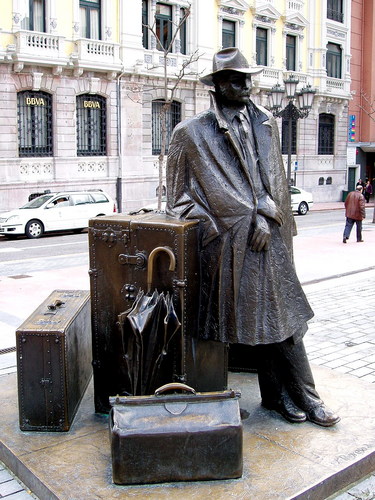
But now thirty years on, during a recent home visit to Canada, thanks to a PBS channel in my hotel room, and a broadcast celebrating the 50th anniversary of Godot, by Jove, I think I got it. Beckett demystified at last. And all because of Dublin's Gate Theatre production on film, produced not much more than three, perhaps four years earlier. Involved splendid actors who hadn't been born yet when the piece ran at the Babylon Theatre in Paris, yet able, would you believe it, to decipher this Godot enigma for me! Chapeau, dear Gate friends, chapeau dear Beckett, for in the end there's nothing to be afraid of or intimidated by, it's a down-to-earth play using simple, splendid rhythmic language written by a down-to-earth man about down-to-earth pre-occupations crossing everyone's mind at one point. Even though the work remains unusually structured, presented with all the tedium and repetitiveness that reflect large parts of life. Through with a bleakness that threw me off for many years, like some scene from arid, outer space planet. A forbidding landscape, leading me to believe the play was about something else for if one thing is certain, and this is that Beckett's story takes place on this earth, not another. A world of ours, if anything, crowded, lush, diverse, not barren, empty, cold, except for Siberia or Tierra del Fuego. And surely a caustic sense of forsakenness, of utter loneliness can be felt in a big city, surrounded by millions, as well I know having lived through moments like these more than once. It's a cruel experience, not pretty, so why not place Godot in the middle of an outdoor market, a football match, a busy cat house---- it makes the feeling of loss, of disaffection 10 times more acute as long as a momentary sense of silent exasperation and alienation is shown to prevail. So that by not doing this, Beckett and his acolytes led me astray for a long, long time. Also, why that tree, Sam? Or why the redundant suggestion of hanging from one—this is clear by itself, innit? You didn't have to spell it out, laddie. It would have been more natural had you given our sweet protagonists some suitcases, only for them to realise they're empty... I mean, what's more poignant than people having no place to go and no place to stay, dragging around vacant luggage? Or you could have introduced a stronger sense of confusion, one character asking the other over and over: Where is he? I'm tired of waiting for nobody to show up....! Are you sure you gave him the right address...? He could stay in our basement, if we had one....!?
(Eduardo Ùrculo's Maletas)
And yes, again, why the sparseness of it all? Can't we hang or roam where it's crowded and moist? Or is the landscape you painted supposed to be the emptiness of existence? But how is that, if people like Vladimir and Estragon, delightful, confused derelicts, not unlike Walt Kelly's anthropomorphic Pogo and company in their Okefenokee Swamp, are so rich and warm? By themselves filling that void, effortlessly enabling us to believe in life; loving it, not hating or fearing it, even though one of these suggested... We've met the enemy, and he's not death; he's us! It's clear to me now that Beckett used a few themes that are not so mind-boggling after all: a) what are we doing here? immediately followed by b) we are abandoned! c) as if this isn't bad enough, some help themselves pass the time by brutalising others. And d) Lucky's soliloquy as a bonus point: massive, empty use of chatter does not by itself create meaning or reflect being. Four basic ingredients then, none of them particularly inaccessable or exclusive to high-brows. In factual terms, when during an interview Beckett was asked if Godot is God, he replied: I have no idea! Surely he was kidding, or if not, deliberately coy and devious, a bit of a pastime with the Irish sometimes. For Godot the play is not existential whatsoever in that it doesn't celebrate existence for its own sake and on its own merit for one single moment. It pines for exterior meaning, not for life. Also, in the country where I currently live the verb for hoping and the verb for waiting are rightfully identical: esperar! As there can be no 'waiting' without 'hope', for what's the point of waiting when there is none, making that where there is 'hope' there can be no absurdity or existential denial... a complete contradiction. I don't know therefore who labelled this work a cornerstone of the Theatre of the Absurd, because to me that notion itself is completely absurd, as, again, suffering from a sense of absurdity would suggest an utter lack of hope, of hopelessness when in fact this work is packed with it. This is not a play about despair, this is a play despairing of despair and why it was performed to offer faith in life, in prisons and to prisoners who had lost it. And yes, if there's something absurd it's the so-called Theatre of the Absurd, but if you're one of those label addicts may I suggest something more in the order of Theatre of Abstract Yearning, given its undeniably expressionistic and 'random' beauty? As a matter of fact, abstract or not, absurd or not, what this particular play does is ache and despair for some sort of divine presence. In fact it questions the value of life without it, so that at its roots Waiting for Godot, though not perhaps in any conventional sense, is a deeply religious play, a Hosanna of a kind. Profoundly nostalgic not for Godot as such, for what's in a name, but for 'a' Godot, any Godot, Godard, Godinot, Godinaud, Godineau, any god, a Pogo, anything, or, yes, God, who the hell cares, as long as he's there, as long we are wanted, as long as we belong! A need for a super outside force to exist for there to be 'meaning' and by implication some sort of servitude to this force, even though Beckett, understandably and given much evident worldly misery was also rightly disillusioned with Godot, Him, him or 'it'. And so all his Angst, yes, truly religious, because the last holy paradox: love of God or some god and at the same time hate of Him or him or 'it', is the living essence of the play. Whereby, and once more with feeling, there's nothing really 'absurd' or 'existential' about any of this, just the expression of frailty all too human and any suggestion that these outcasts are suicidal to me completely out of line precisely because they're still 'waiting' for something, and this something ain't death.... Tell him that you saw us… not a lament therefore. It is not a rejection or even a charged sarcasm. It is a plea, a prayer, with a longing in it that makes everything else in the play doleful camouflage. Yes, Beckett might as well have called his work Pining for Godot, and all this camouflage the source of my not understanding the work earlier. Tell him…. where Beckett through the boy implores God, some god, (who else, indeed, Sam?) to come, manifest and eventually explain Himself; and that is where it should have ended. Despite the actual last lines of the play, saying Where shall we go? Let's go…. literally and figuratively leading nowhere, suggesting we're lost. Because here, for someone like me, isn't nowhere and thus the need to go elsewhere not imperative or by the lack of a specific direction or destination making me feel particularly lost. Besides, all this sitting around needlessly 'waiting' and 'hoping' also contains an element of torture, for which someone like me has very little appetite.
Samuel Beckett then, while carefully admitting nothing, at the very least got a little lost in his own exasperations. It is why I was so confused, and delighted to have discovered that all the others, particularly those literary establishment Popes, then and presumably still now, had no freaking clue about the play or ever knew at the time what they were talking about. Yet thanks to this brilliant Gate production I have arrived at these conclusions only scant weeks ago. (Or am I merely maturing at last, and none too soon…) Then again, there might be hope for me: Beckett was my age when he broke through, and still then not getting all of his beautiful stuff…. quite right. Or did he? Is waiting a real option for so many? Well, for some perhaps but again, as for me, why don't we just live life first and let the ball drop where it must! Like waiting for a city bus: if it turns out it got cancelled or doesn't even exist, don't give in, don't give up, keep walking, enjoy the roadside's hidden magnificence, a place where to be is to do, no taste for death, no place for doom. The voyage all that matters, the destination practically... immaterial! Now that is 'existential', and something not 'absurd' or meaningless merely because it cannot easily be explained. I suspect Beckett would even agree with me that life is not absurd whatsoever, that on the contrary from a strictly human point what's really absurd is the wasting of one or worse, the cruelly taking away of one. Finally, as far as this remarkable, liberating production of The Gate Theatre itself is concerned, in the master/slave relationship twixt Pozzo and Lucky (as always with Beckett, dark humour in this very name, just like Krapp's Last Tape should perhaps read Tape's Last Krapp, and the breakfast sounding Hamm & Nagg in Endgame, or like Estragon here, nice name, fine herb, almost Greek, almost classic, almost Antigone, almost Sophocles, but surely codes telling us he didn't wish to be taken all that seriously), 'master' Pozzo speaks with a pronounced upper-class English accent, and 'slave' Lucky (!) in thick Irish brogue. Is The Gate Theatre reminding us here of something? Re-asserting and magnifying victimhood and old slights on the cheap, or is this a small coincidence? The former being the case would be most regrettable, as universality surely was Beckett's aim, not stale, political beefs, dating back a century or more.
Help Critical Thought Survive, Help Total Literary Originality; Any small donation is Deeply Appreciated:
21/02/03
|
||
| Incorporate Diaper Ad: Waiting for Dodot |